Mark My Words: How harnessing AI could transform night-time breathing support for people living with MND
Every day the teams at The Institute for Breathing and Sleep and the University of Melbourne at Austin Health work closely with people affected by motor neurone disease (MND) to navigate one of the most fundamental challenges of the illness. Breathing.
For many people with MND, restful sleep depends on non-invasive ventilation (NVI). When everything works smoothly, NIV can restore comfort, strengthen quality of life and, in some cases, help people live longer. But when the technology slips out of sync with a person’s breathing pattern, the benefits can quickly unravel. Known as patient–ventilator asynchrony, the issue can leave people frustrated, exhausted and often hesitant to continue using NIV at all.
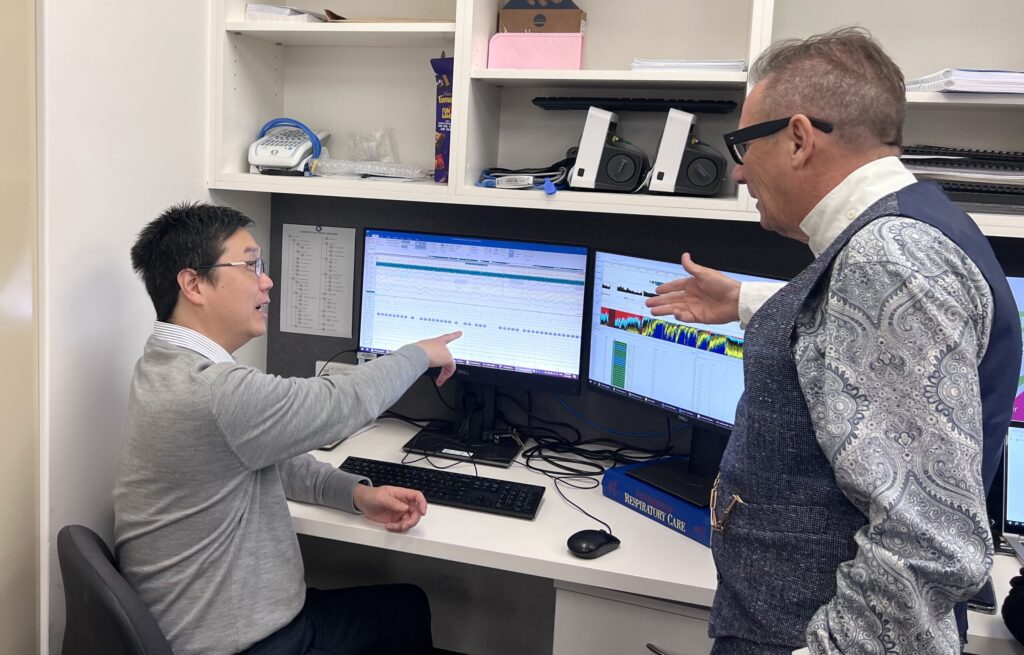
Professor David Berlowitz, together with the Victorian Respiratory Support Service team, have seen the challenges of patient-ventilator asynchrony firsthand. They work closely with Australians affected by MND to manually correct unsychronised ventilation, and while their manual adjustments help many people, they knew a more seamless and dependable approach was needed.
Enter Anthony Stell and the Computing and Information Systems team from the University of Melbourne, led by Professor Uwe Aickelin, engineers driven to use technology for human good. The worlds of clinical care and AI came together. David understood the problem. Anthony and the team knew how to build the solution.
Together, they created a collaborative research project to develop algorithms which mimic what expert clinicians do manually. Using data from a large, multi-centre clinical trial across Australia and Canada, the team is training AI models to detect changes in patients’ breathing, with an aim to automatically adjust NIV in real time.
The trial is guided by a stakeholder advisory committee, ensuring that people living with MND and their families help shape every stage of the research. Once the algorithm is accurate and robust, the team plans to work with the committee to support implementation.
While the engineering is complex, the motivation is deeply human. David explains, “We sleep for one-third of our lives, and we all understand how a good sleep makes us feel better.” He knows that when NIV works seamlessly, individuals and families notice the difference every morning. “If our project is as successful as we hope, the person with MND and their families should notice the difference.”
The team is already looking ahead. With promising early results, they aim to integrate the AI directly into ventilator devices. “Next steps would be the integration of this software algorithm in the ventilators themselves,” Anthony says. A key step to bringing the innovation from the lab into homes worldwide.
Along the way, the partnership between clinicians and engineers has proven invaluable. Anthony reflects, “The capacity building between clinical and engineering domains is enormous.” For David, the project is a natural continuation of decades of listening, learning, and responding to the needs of people living with MND. “This research question has emerged from our program of clinical and research work with people living with MND,” he explains.
None of this progress would have been possible without FightMND’s support. “Without FightMND funding this would have been a much greater challenge to achieve,” David and Anthony emphasise. Looking ahead, the pair see even greater possibilities for AI. “Our hope is that similar uses of machine-based approaches can not only support treatments but be used to improve the process of research into deep understanding of MND and its causes.”

Mark My Words: Your support powers vital research
David and Anthony’s work is just one example of how technology, including AI, can improve the quality of life for Australians living with MND. This year, you can help fund the next wave of vital MND research. Every dollar raised helps FightMND support projects that improve care today while moving closer to the breakthroughs of tomorrow.
Every donation accelerates research, funds innovative care and empowers people living with MND. Mark my words: your support can change lives. Stand with Australians affected by MND. Together, we can keep pushing forward, investing in bold research, supporting families and creating a future without MND.