An icy world record falls to launch DIY Big Freeze for 2026 

An icy world record falls to launch DIY Big Freeze for 2026 

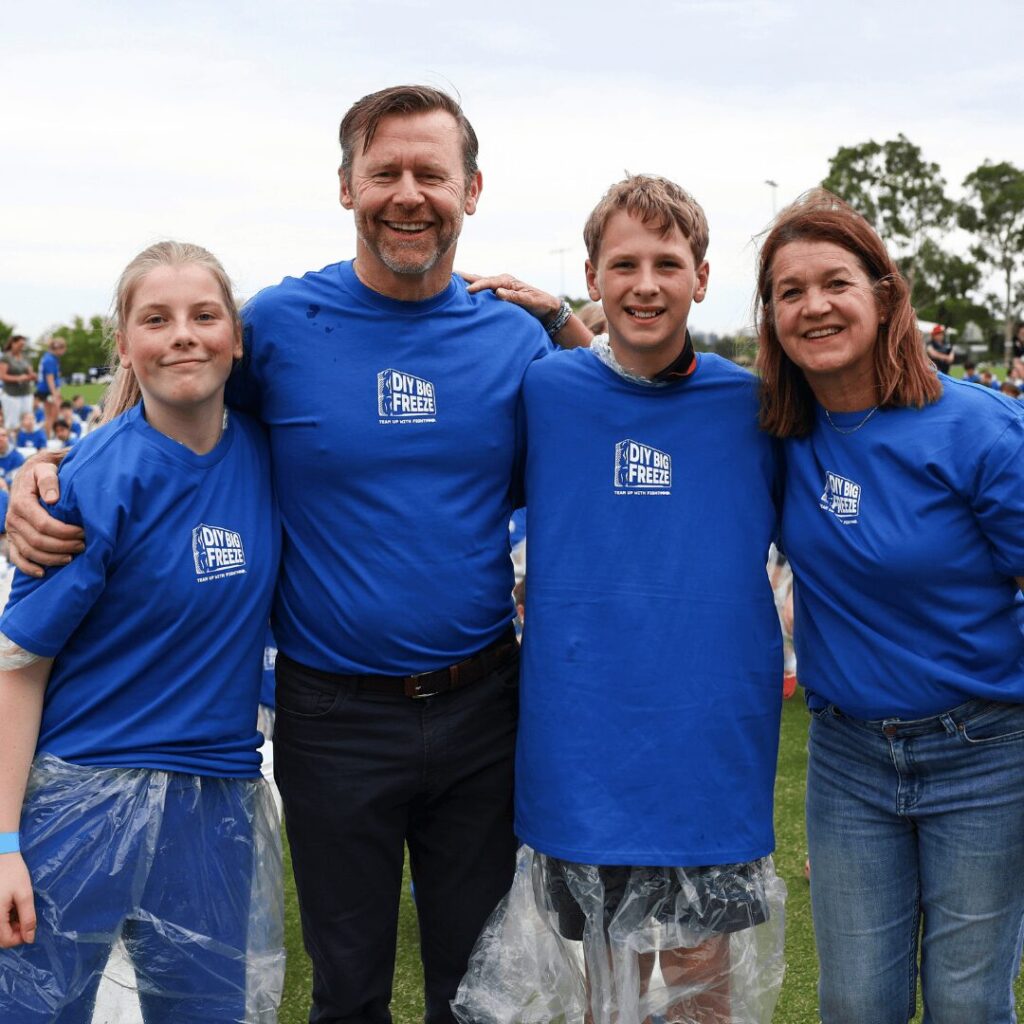
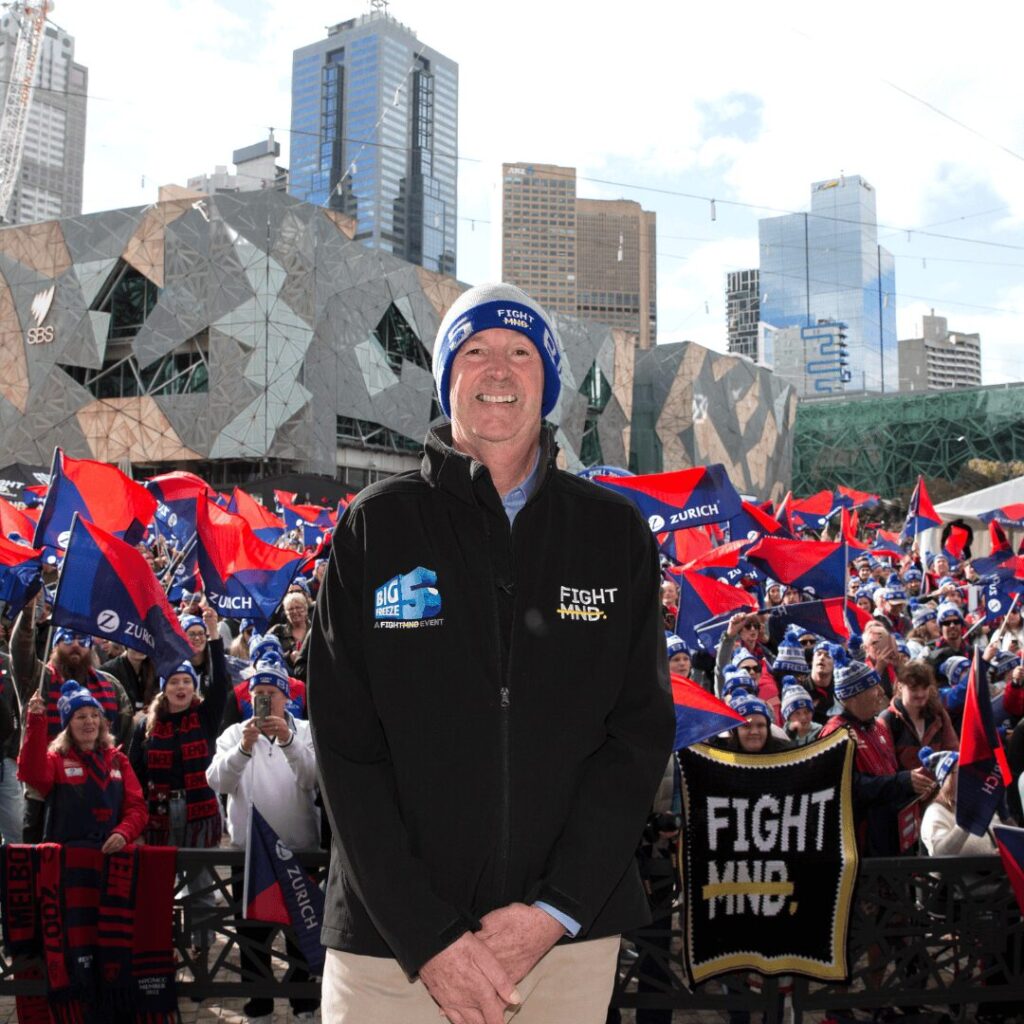
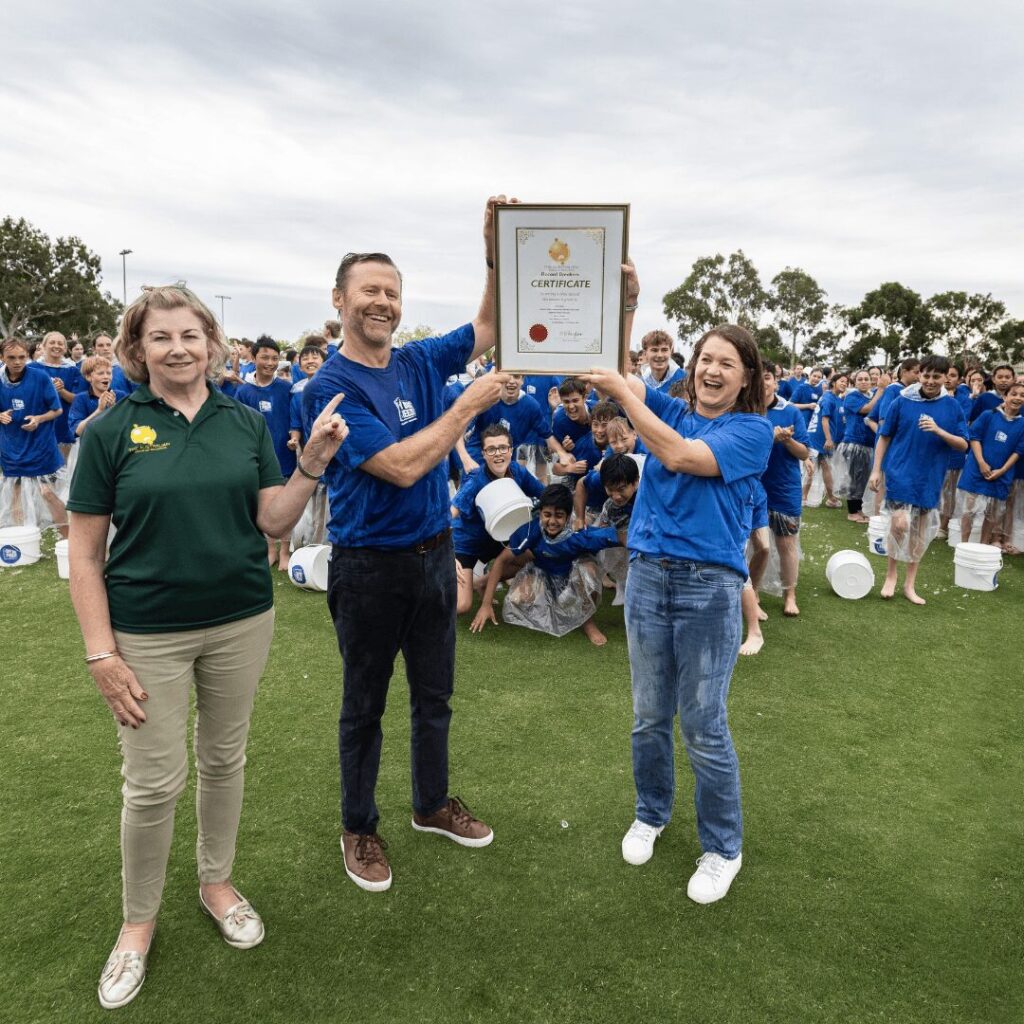
This morning 979 students from 12 schools across Melbourne descended on Xavier College in Kew. Their mission? To set a new world record for the largest simultaneous Ice Bucket Challenge and help raise awareness of motor neurone disease (MND).  

After the countdown, thousands of litres of icy water drenched students and participants in a wave of exhilaration. In that moment, Melbourne schools officially set a new world record. The achievement was confirmed by Helen and Faye from the Australian Book of Records, who presented FightMND’s Jan Daniher and Pat Cunningham with a certificate acknowledging the milestone.  

While the event created a memorable moment for participants, its primary purpose was to increase community awareness of MND; a disease affecting more than 2,700 Australians, as well as their families, friends and support networks. The gathering demonstrated the important role schools and young Australians can play in educating communities and supporting those impacted by the disease. 

For the Xavier College community, the event held a particular significance. Pat Cunningham, a Xavier alumnus and Co‑founder of FightMND, has been an advocate for MND research since his wife Angie’s diagnosis in 2013. The record attempt also honoured Jon Catania, a member of the Xavier College Class of 2017, who passed away from MND in 2025. The initiative recognised Jon’s legacy and highlighted ongoing national efforts to invest in research and improve the quality of life of Australians living with MND. 

The Ice Bucket Challenge also celebrated Melbourne’s sporting connections with the fight against MND. Tom McDonald, son of Melbourne Football Club legend Anthony McDonald participated in the challenge. Showing that this fight spans generations. McDonald was coached by Neale Daniher during his time with Melbourne. Neale’s own experience with MND has inspired national awareness and advocacy for increased funding for MND research and support services.  
FightMND would like to thank Xavier College for generously hosting and participating in the record attempt. We would also like to thank all the schools who helped make this record happen, including: 

  • Catholic Ladies College, Eltham 
  • Genazzano FCJ College, Kew 
  • Kew Primary School, Kew 
  • Loreto Mandeville Hall, Toorak 
  • Loyola College, Watsonia 
  • Marymede Catholic College, Doreen 
  • Our Lady of Good Counsel Primary School, Deepdene 
  • St Anne’s Primary School, East Kew 
  • St Francis Xavier Primary School, Montmorency 
  • Strathcona Girls Grammar School, Canterbury 
  • Trinty Grammar School, Kew.  

FightMND would also like to thank our event supporters: 

  • Bunnings for donating 1,500 buckets 
  • Coles for 1,100 each of bottles of water and Fredo Frogs 
  • Bells Ice for 200 bags of ice 
  • Camprint for t-shirts at a discounted rate  

The record‑breaking Ice Bucket Challenge also reinforced the simplicity and accessibility of hosting a DIY Big Freeze event. With an idea, determination and participants to help beat the Beast that is MND, schools, workplaces, sporting clubs and community groups can create their own activities to raise funds, build awareness and show support for Australians living with MND throughout 2026.  

Quotes 

Shane Healy, Director of Operations and Community, Xavier College 

“Xavier seeks to form boys into ‘Men for Others’. To assist a wonderful charity such as FightMND is what the College is all about – we’re proud to support MND in this excellent endeavour.” 

Tom McDonald, Year 8, Xavier College, son of Anthony McDonald, former Melbourne Football Club player 

“My dad got coached by Neale. This is such a good cause and we all get around it as a family. We talk with Neale every year. We go down and have a dunk in the river and send it to Neale to show him that we’re doing the Big Freeze ourselves. It’s really exciting to be doing the DIY Big Freeze today, and all of my friends are ready to be involved.” 

Matt Tilley, CEO, FightMND 

“DIY Big Freeze means that you’re bringing the magic of what happens at the ‘G’ to your footy club, your workplace, your netball club or your school and raising money for us. That’s one part of it. But the big part is coming together and having fun and bringing some awareness around FightMND, what we do, the disease MND and what a terrible thing it does to families. 

But this year we have a little trick up our sleeve as well. One lucky duck is going to slide down the mega slide at the ‘G’ on King’s birthday weekend. And if you want to be that lucky duck, all you have to do is register and set up your own DIY Big Freeze and you’re in with a chance.”  

Jan Daniher, DIY Big Freeze leader, FightMND 

“How exciting is this – If you register for a DIY Big Freeze, you go into the draw to go down the Big Freeze Slide at the MCG on King’s Birthday. Now, this is a once in a lifetime opportunity. We’re so excited and we can’t wait to see who gets to go down that famous Slide.” 

“Seeing the community rally behind this cause gives me so much confidence for the future of this fight. Their willingness to step forward shows the power of people. When we come together, families affected by MND are reminded that they are not facing this alone.  

This is exactly why DIY Big Freeze was created. To bring people together and build momentum for change. Every DIY Big Freeze, big or small, helps build hope. Each one brings us closer to better treatments, better support and a world free from MND.” 

Host a DIY Big Freeze for your chance to go down the Big Freeze Slide 

This year one lucky person will get the chance of a lifetime! To go down the famous Big Freeze Slide on King’s Birthday. All you have to do is register your DIY Big Freeze for your chance to go into the draw to win.  

By hosting a DIY Big Freeze, you can bring the magic of the MCG’s Big Freeze to your own community. Whether it’s an Ice Bucket Challenge, selling Socks and Beanies, or your creative take on the iconic slide, every gesture fuels critical MND research and care programs supporting Australians living with the Beast. 

Joining the fight begins with a choice. I Choose Fight. Will you?  

This Big Freeze, unite your community, make a splash and bring us closer to a world free from MND. Learn how you can host a DIY Big Freeze on our website. 

Swimming for Rita: Madoc’s mission to fight MND 

Swimming for Rita: Madoc’s mission to fight MND 

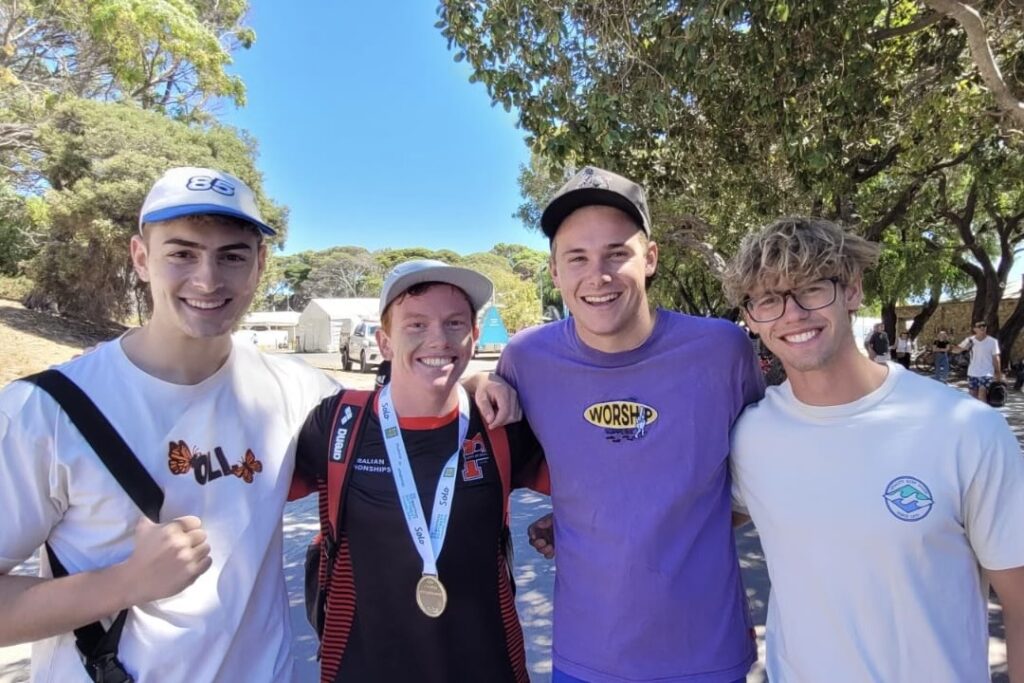
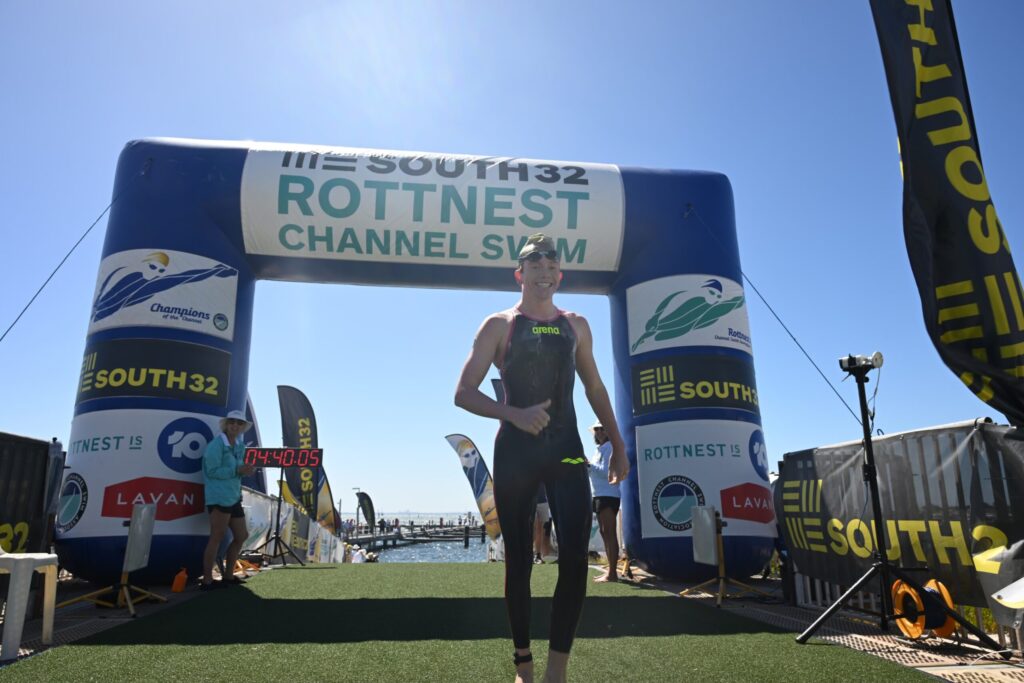
For Madoc Lanfear-Appleby, swimming is more than a sport. In 2025, it became a way for him to honour his family, raise awareness and help fund important research into motor neurone disease (MND)

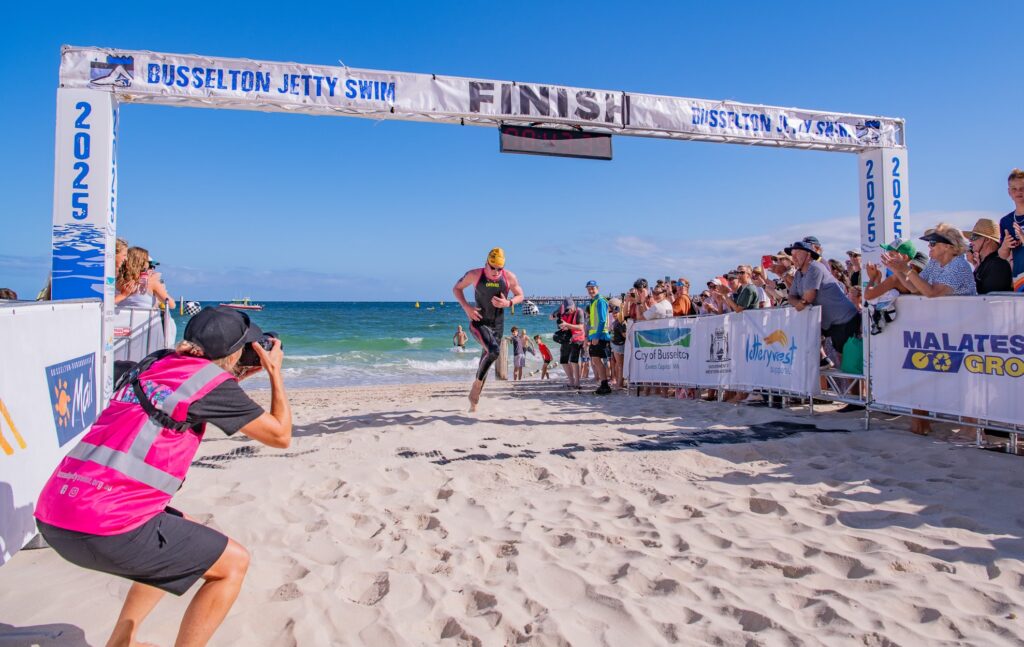
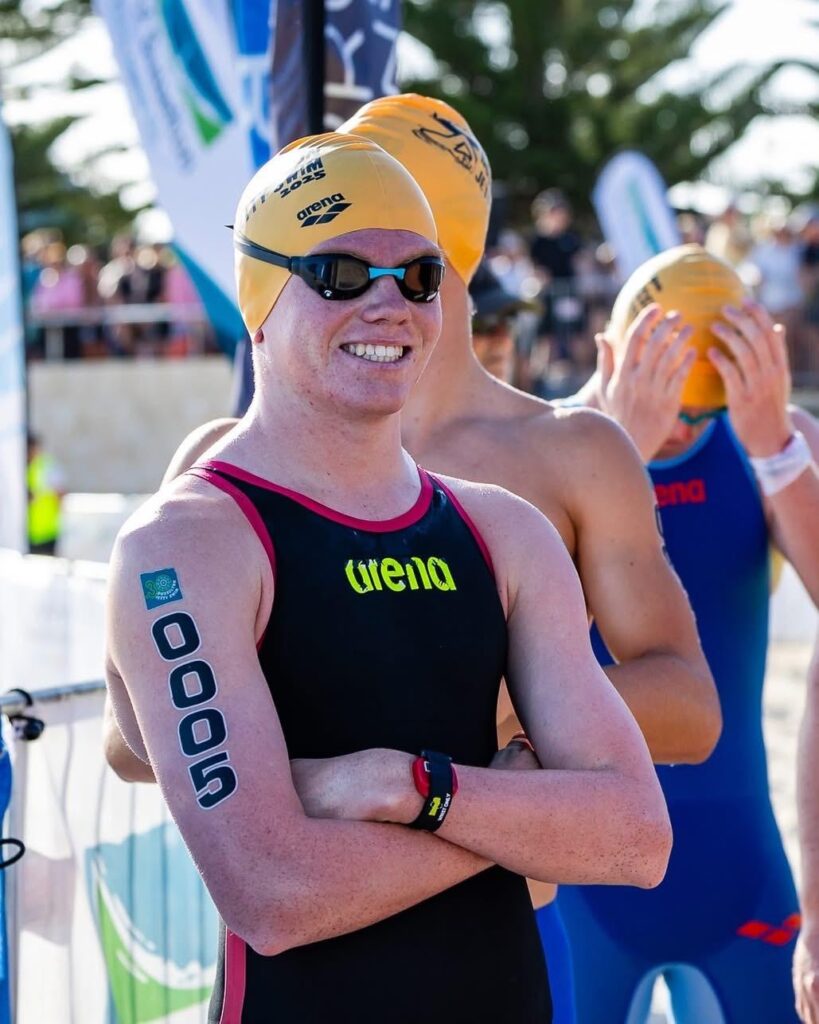
The challenge Madoc set himself was no small feat. “I have always wanted to raise funds for MND and I thought attempting to complete two solo Rottnest Channel swims in a month would be a good challenge,” he explained. A demanding physical challenge. But one driven by deep personal connection.  

The fight against MND sits close to Madoc’s heart. In June 2015, his Nanna, Rita, was diagnosed with progressive bulbar palsy. An aggressive form of MND, it primarily affects speech and swallowing. It has a life expectancy of just six months to three years. Rita passed away on 22 December 2016, just 18 months after her diagnosis.  

Madoc remembers Rita as a passionate swimmer, an active and social person who loved being out in the world with others. Losing her independence was one of the hardest parts of the disease. “The hardest thing for Rita was losing the ability to talk, walk, and swallow,” he said. 

Being confined to a wheelchair and relying on others was mentally tough for someone so independent. Yet even as MND took so much from her, Rita refused to let it take everything. 

“When Rita lost her speech, she started communicating through handwritten notes. She was so determined that she mastered the art of using an iPad and started using social media to communicate and connect with people.” 

It was Rita’s unwavering determination that Madoc held onto. The fuel that kept him training hard for the challenge ahead. 

A challenge years in the making 

Reflecting on his goal, it’s clear Madoc wanted a challenge worthy of the determination Rita showed every day. “Swimming to Rottnest seemed like the right one,” he explains.  

The journey hasn’t been simple. His plan for two solo swims in a month back in 2024 was interrupted when severe weather forced the Rottnest Channel Swim to be cancelled mid-race. Stepping back from competitive swimming afterward, Madoc shifted his focus from racing to resilience. “I’ve been able to complete three solo swims to Rottnest Island since and this year, my goal is simply to make it to the island,” he says. 

With years of experience including team crossings, solo attempts, a cancellation, and time spent paddling for others, Madoc knows exactly what the channel demands. “Everything I’ve learned shapes how I train and how I’ll tackle the day,” he explains. 

Training now is about balance: managing fatigue, protecting his body, and fitting preparation around everyday life. “The most important thing is learning how to manage my body. The fatigue, the sleep,” he says. 

Behind him stands a tight-knit crew of friends and family; paddlers, boat support and beach crew, who power his confidence as much as his strokes. “These people mean so much to me,” Madoc reflects. “They give so much of their time to help me chase my dreams.” 

Why it matters 

For Madoc, swimming to Rottnest is only part of the journey. What truly drives him is the hope of creating change for people living with MND.  

“I hope my efforts will assist in raising awareness for this cruel disease. And the funds raised will help assist in research and help with supporting families impacted MND with medical treatment and equipment to help them get through really tough times and make the smallest thing such as communicating slightly easier.” 

The impact of MND is devastating. Every single day in Australia, two people are diagnosed with the disease and two people lose their lives to it. Right now, more than 2,700 Australians are living with MND, and that number is expected to rise to around 4,300 by 2050.  

“It’s obvious that this disease can affect anyone, whether that be yourself or someone you may even know.” 

Taking the leap for FightMND 

For anyone considering a challenge to support FightMND, Madoc’s advice is simple. “Do it!” he exclaims. “As my parents say, ‘You only regret what you don’t do. Not what you do,’”.  

Madoc is someone who hasn’t found fundraising a natural thing to do. “I’ve always been too shy to ask people to donate their own money. I don’t like putting any pressure on people,” explains. But, reframing his purpose changed his view. “I’m not fundraising for myself,” Madoc explains. “You’re doing this for everyone affected by this horrible disease.” 

Representing FightMND and swimming in honour of his Nana and every one affected by the Beast is something Madoc carries with deep respect.  

“Being able to represent this amazing charity and the people suffering from MND makes me feel honoured and privileged to be in the position to swim these swims for them.” 

How you can get involved 

Madoc’s journey is a reminder that the fight against the Beast takes people. Whether it’s swimming, walking, cycling, hosting an event, or taking on a personal challenge, there are many ways to fundraise for FightMND. 

You don’t need to swim the Rottnest Channel to help change lives. You just need a goal and a reason. Together, through challenges big and small, we can raise awareness, fund research, and support families affected by MND. 

If you’ve been thinking about doing something meaningful, this is your sign. Learn more about how you can fundraise for FightMND on our Ways to support page. 

Julie’s Story: From discovery to possibility in MND research 

Julie’s Story: From discovery to possibility in MND research 

For people living with motor neurone disease (MND), time is everything. With limited treatment options and rapid disease progression, the need for new therapies has never been more urgent. 

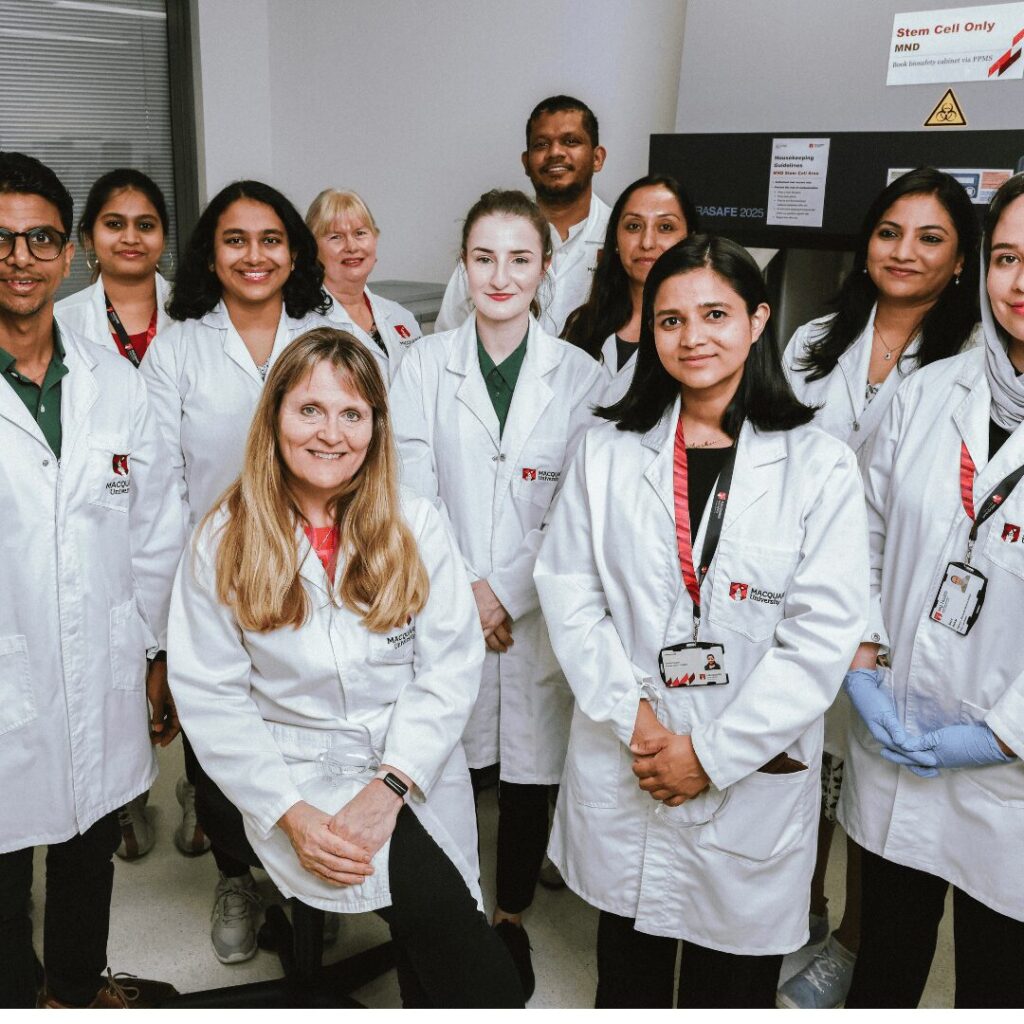
That’s why Professor Julie Atkin, Professor of Neurobiology at Macquarie University’s Macquarie Medical School, is leading a promising new research project supported by a 2025 FightMND Drug Development Grant. 

Julie’s project, Repurposing Diazepam as a New Therapeutic Approach for MND, takes a practical and innovative approach; investigating whether a widely used drug could be redirected to treat MND. 

“This project will examine whether a known drug, for which extensive research already exists, has the potential to be a new treatment for MND,” Julie explains. Diazepam is a medicine that has been used by doctors all over the world for more than 60 years. Because it has been studied so much, scientists know it is safe, easy to access, and affordable. This makes it a strong and practical option to test as a possible new treatment for MND. 

Repurposing existing medicines can reduce the time and cost required to bring new treatments to patients. While developing a new drug can take up to 20 years and cost billions of dollars, repurposing could reduce that timeline to just a few years. For a disease like MND, where progression is rapid and options are limited, this efficiency could be transformative. 

Julie’s team will test diazepam in mouse models of MND that develop paralysis, muscle weakness, impaired movement, and motor neuron loss similar to those seen in people with the disease. “If the drug prevents these key features in MND mice, it will provide strong evidence of its potential to treat these characteristics in humans,” Julie says. 

Importantly, the research targets early disease mechanisms. Motor neurons become overactive early in MND, and abnormal accumulation of the TDP-43 protein, a hallmark of the disease, occurs in around 97 per cent of cases. Targeting these processes early may offer a more effective therapeutic strategy than treating symptoms later in the disease course. 

People living with MND are already helping shape the research. Julie’s team has engaged with the Australian Lived Experience Network and works closely with the Macquarie Neurology Clinic, which cares for around 10% of Australia’s ALS patients. This close connection ensures the research remains grounded in real-world needs and priorities. 

This work would not be possible without FightMND’s support. “Preclinical drug development is extremely difficult to fund, yet it is a critical step in translating discoveries into treatments,” Julie says. “Without FightMND’s support, it would be impossible for us to test whether this drug has the potential to be repurposed for MND. By funding projects like this, FightMND is addressing a vital gap in research and accelerating the search for effective therapies.” 

Celebrating women in MND research 

Professor Julie Atkin is just one of many extraordinary women leading vital research into MND in Australia and around the world. Female scientists are advancing MND research at every level; from uncovering the biological mechanisms driving the disease, to developing and testing urgently needed new treatments. 

Their work extends beyond the laboratory, connecting science with lived experience through collaboration with clinicians, patients and families. By mentoring early‑ and mid‑career researchers and championing innovative ideas, these women are helping to build a stronger, more connected MND research community for the future. 

On this International Day of Women and Girls in Science, we celebrate the dedication, leadership and compassion of women like Julie, whose research brings hope to people affected by MND. To all the incredible women working to help us beat the Beast: thank you for your science, your determination and your commitment to a world free from MND. 

From ideas to action: What happens after the Global MND Research Roundtable

From ideas to action: What happens after the Global MND Research Roundtable

When the 2025 Global MND Research Roundtable closed, the conversations didn’t stop. They sparked action.  

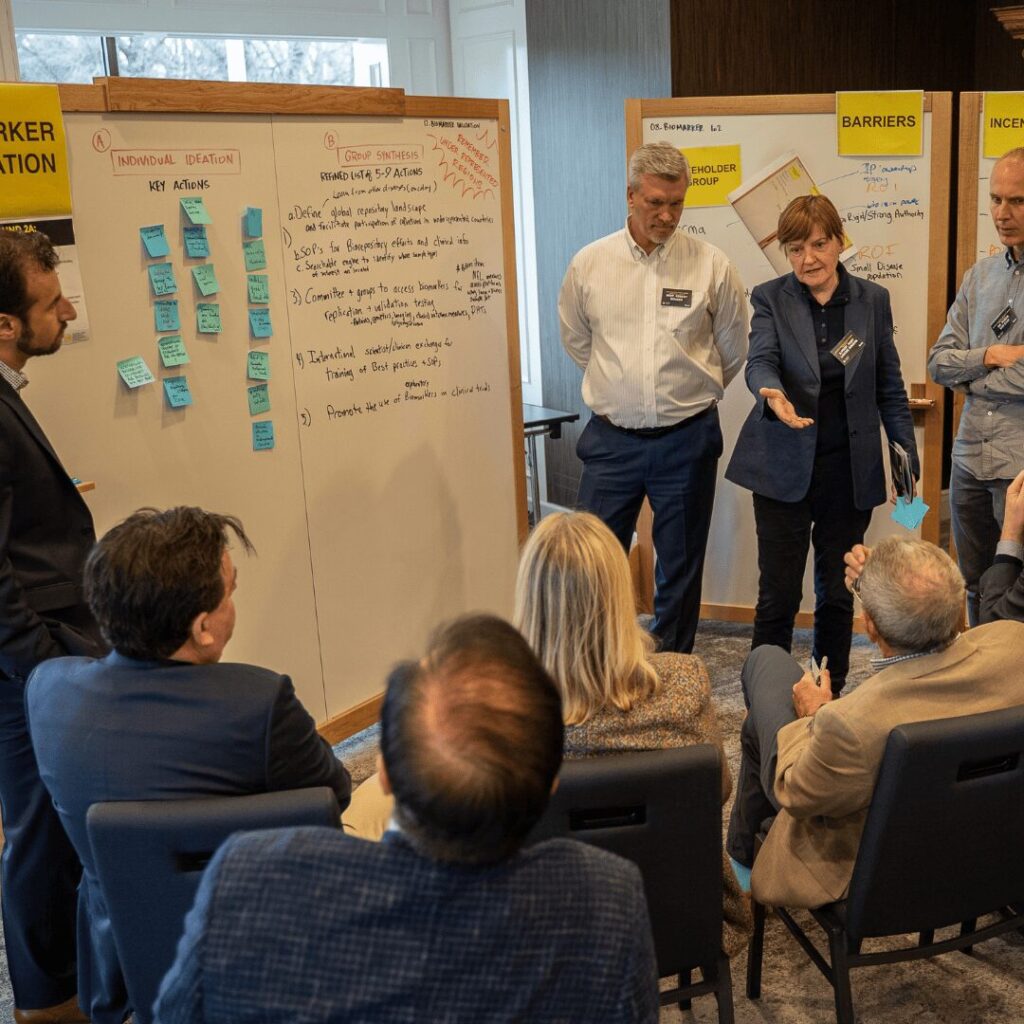
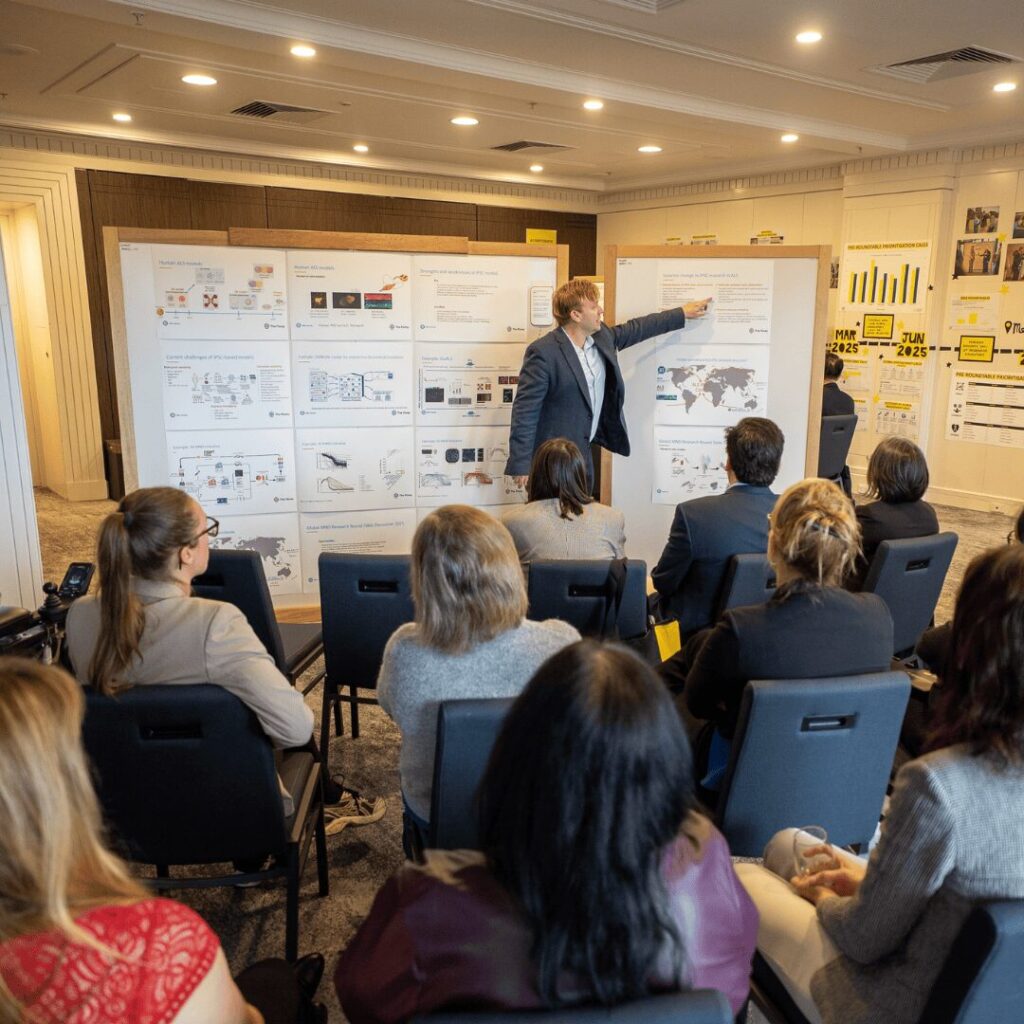
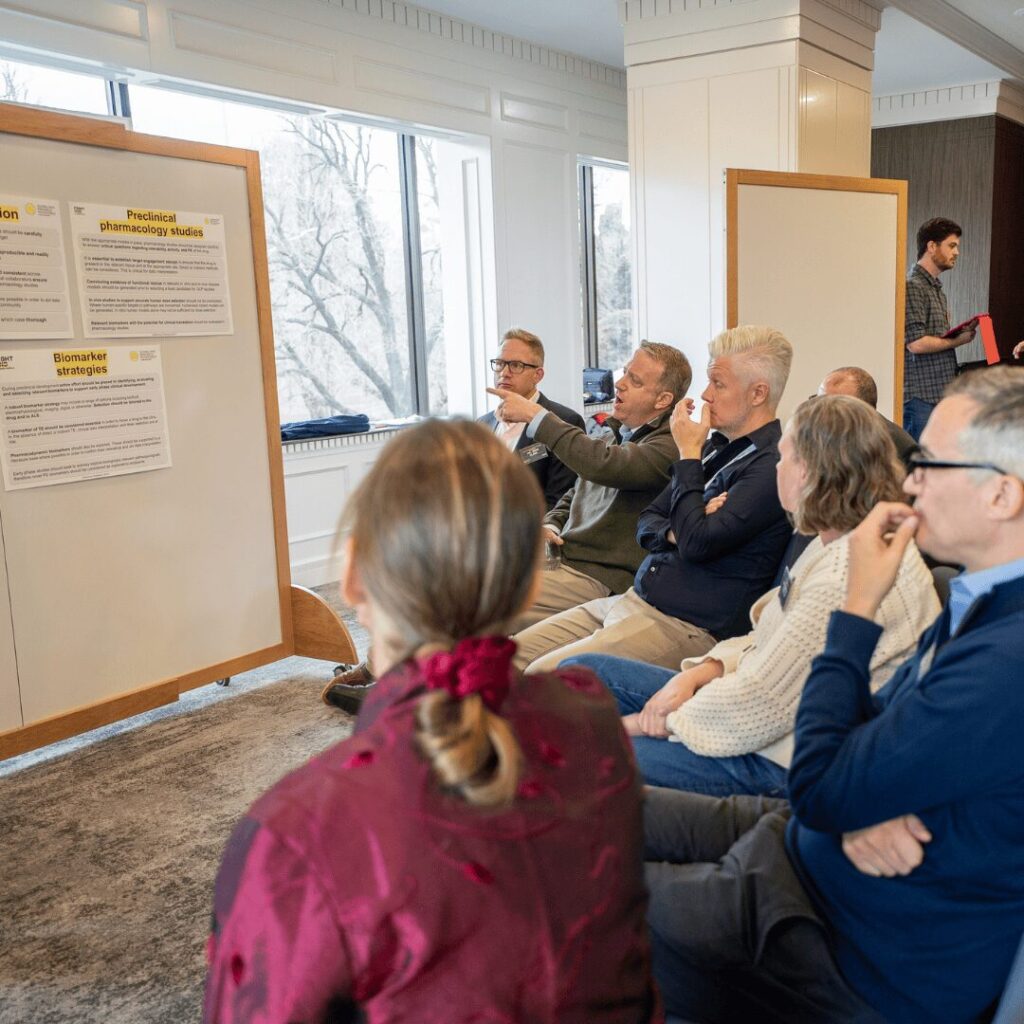
The Roundtable brought together researchers, clinicians and experts from around the world. Together they had a shared goal: to make faster, meaningful progress against motor neurone disease (MND). Over two days, participants exchanged, debated, and refined ideas. Collaboration was key to deciding what matters most in MND research.   

By the end of the Roundtable, there was a clear outcome. The group agreed on five clear, achievable priorities that could advance MND research. They emphasised that global collaboration is essential for making real progress. 

From agreement to action 

After the Roundtable, FightMND and ALS Canada developed a detailed report. This report ensures the priorities identified during the Roundtable lead to real change. The report included key discussions, decisions and agreed outcomes. It provides a clear roadmap for what needs to happen next. 

But the Roundtable leaders knew that ideas only matter when they lead to action. The next step was to bring the right people together to deliver progress. 

Building the teams to deliver change 

Currently, working groups are being formed to take responsibility for each of the five priorities. These teams will shape and lead projects. They will strengthen collaboration and turn shared goals into action and meaningful outcomes. 

Each group brings together leaders with different skills and experiences. Care was taken to include diversity across gender, geography, career stage, and lived experience with MND. Many participants are new to the Roundtable, adding fresh thinking and new perspectives. 

The response from the global research community was positive. More than 90% of invitees accepted. Positive word-of-mouth from past participants inspired many participants to join.  This engagement shows a strong belief in the Roundtable’s initiatives and collaborative approach. 

What happens next 

The next stage is already in motion. The first meetings for each group will begin in February. These meetings will mark the start of each project. Together, the working group will set clear goals and timelines for their activities.  

A project manager funded by FightMND and ALS Canada will help move these projects forward. This role will provide crucial coordination and support across all groups and maintain momentum. Recruitment for this position is underway. 

Why these outcomes matter 

This structured, action-focused approach turns global discussions into real impact. The Roundtable is helping accelerate progress in MND research. By uniting experts and giving them clear priorities, strong leadership and proper support, we can move towards a future free from MND.  

It’s encouraging to see so many leaders willing to share their time, expertise, and energy. Their commitment shows a shared belief: strategic focus and collaboration provide the best chance for breakthroughs. 

Watch the Roundtable in action 

Hear from participants about how global collaboration is driving the next phase of MND research in our Roundtable video.  

The Global MND Research Roundtable is moving from conversation to action. These outcomes and next steps show real progress toward meaningful change for people living with MND. 

A new chapter in Australia’s fight against MND 

A new chapter in Australia’s fight against MND 

FightMND welcomes the Federal Government commitment of $40.1 million over four years to support the establishment of the Neale Daniher National MND Clinical Network. This investment supports the creation of a coordinated national approach to MND research, ensuring every Australian, regardless of where they live, has equal access to the emerging therapies of tomorrow.  

This significant national investment marks a major milestone in the journey that began with our founders, Pat Cunningham, Dr Ian Davis and Neale Daniher, and has grown into a movement united by determination, hope and a shared belief that together we can change the future of MND. 

The Network honours Neale’s extraordinary legacy and strengthens Australia’s capacity to deliver world‑class care today while accelerating the breakthroughs of tomorrow. 

A commitment to strengthen Australia’s response to MND

This four-year commitment will establish a nationally coordinated system to transform how MND is diagnosed, researched and treated in Australia. This funding is structured across four complementary pillars designed to strengthen Australia’s clinical trials capability, data and diagnostics, workforce and models of care. 

What the network will deliver 

The Neale Daniher National MND Clinical Network represents a major shift in how Australia tackles MND. Instead of operating in isolated pockets, clinicians, researchers, hospitals and health services will be brought together into a coordinated national effort. 

The Network will: 

  • Establish Australia as a core destination for MND clinical trials globally, expanding access to emerging therapies, attracting international trials and improving participation for people in regional, rural and remote communities. 
  • Lead MND diagnostic and therapy development through data, strengthening national data capability and addressing critical gaps in understanding disease progression and risk. 
  • Develop the world’s best clinicians and researchers, investing in fellowships and training to build a strong, sustainable specialist workforce with specialised MND clinical research expertise. 
  • Advance research into MND clinical care, supporting projects that improve care pathways and models of care across Australia. 

For the first time, this coordinated approach will streamline how treatments are developed, tested and delivered, ensuring every Australian living with MND has access to the highest standard of care and the latest emerging therapies, regardless of where they live. 

Positioning Australia as a global leader 

This milestone positions Australia to lead, not just contribute to, the global effort against MND. With national coordination, world‑class infrastructure and the support of the Federal Government, Australia is now better placed than ever to attract international research partnerships, biotechnology investment and the most promising new therapies for Australians. 

One piece of the puzzle in a bigger fight 

The Federal Government’s four‑year commitment to establish the Neale Daniher National MND Clinical Network is a critical step forward. But it is only one piece of the puzzle in the broader fight against MND. This disease is complex, relentless and multifaceted. There is no single solution and no single treatment will work for everyone.  

The progress that brought us to this moment has been powered by the Australian community. For years, families, donors, volunteers and supporters have stood shoulder‑to‑shoulder with FightMND. Their support has helped raise awareness, fund world‑class research and build the clinical capability shaping the case for this national Network. Their dedication has driven momentum, sharpened Australia’s research focus and ensured that MND remains impossible to ignore. 

This Network is an important step forward. It shows what we can achieve when people work together to support MND research. Even with this progress, the challenge ahead is still big. Motor neurone disease moves faster than the treatments we currently have. Long term support is important to turn scientific ideas into real improvements for people living with the disease.  

FightMND will keep working to invest in vital MND research and care programs supporting Australians affected by MND.  

Government support plays an important role and the passion and generosity of the FightMND Army adds incredible strength to the fight against the Beast. Together, we can keep driving progress and provide hope for everyone affected by MND.  

Quotes 

The Hon Mark Butler, Minister for Health 

Neale Daniher has led a tireless fight for the MND community, accelerating research and giving hope to thousands of Australians. MND is one of the most harrowing conditions we face. It is progressive, fatal, and there is no known cure . We want to accelerate the development and delivery of effective treatments – and ultimately a cure – for motor neurone disease. With the establishment of the Neale Daniher MND Clinical Network we hope to improve outcomes for those living with this devastating condition.  

Neale Daniher, Co-founder and Patron, FightMND 

When I was named Australian of the Year in 2025, I asked the community to imagine. Imagine unlocking the mysteries of the neurological frontier right here in Australia. This funding commitment from the Albanese Government is a powerful step forward in this fight against the Beast.  

The science is advancing; the momentum is building and the establishment of the Neale Daniher National MND Clinical Network strengthens the foundations needed to drive real progress. This investment isn’t for my benefit. It’s about laying the foundations, so others don’t have to go through what I have. I’m deeply grateful for this support. It is going to help turn hope into action for future generations. 

Dr Bec Sheean, Director, Programs and Cure Research 

Neale’s tireless commitment and work has completely changed the landscape of MND research in Australia, particularly when it comes to clinical trials and research. This announcement of support from the Federal Government will turbo charge these efforts and reinforce Australia’s position as a leader in the fight against MND.  

Investment in the Neale Daniher National MND Clinical Network will power the community of passionate and committed MND research clinicians to better understand Australians living MND both as a population but also as individuals, recognising gaps in access to care and research and fast-tracking discoveries as we better understand the disease and how to treat it. The ultimate goal is that the Neale Daniher National MND Clinical Network will allow all Australians who are diagnosed with MND to have access to specialised MND care, assessment and targeted treatments. The right drug for the right patient at the right time. 

The MND research community is incredibly grateful for this significant support for this incredibly important program of work. 

Bec Daniher, Executive Director, Strategic Alliances 

Dad has always believed that when people join forces, they can create something far greater than anything they could do alone. This announcement brings that belief to life. The Federal Government’s four-year commitment is an important piece of the puzzle in the fight against MND, strengthening national coordination across clinical trials, research and care. 

The progress that led to this moment has been driven by the unwavering support of the FightMND Army and the wider Australian community. MND is complex, and there is no single solution, so we must keep pushing on every front—funding innovative research, accelerating clinical trials and giving scientists the tools they need to take on the Beast. 

On behalf of our family and the FightMND community, thank you to the Federal Government for this decisive commitment. It honours Dad’s legacy through action, hope and momentum toward a future free of MND. 

Janine and Paul’s story: A legacy of love, courage and hope 

Janine and Paul’s story: A legacy of love, courage and hope 

Janine had a rare gift. She made people feel seen and cared for. At Bunnings, where she became affectionately known as “Mum”, her kindness reached far beyond the Special Orders Department. Whether she was guiding a tradie through a complicated job or helping a first time DIYer find the courage to tackle a project, Janine gave everyone her time, her patience and her belief in them. As a union representative, she fought fiercely for her team, protecting and uplifting colleagues as though they were her own children. “Janine was always looking to help others,” recalls her husband, Paul.  

At home, Janine and Paul built their lives around spending time together. With both working shift jobs, they planned their days so one of them was always there for their children. Family meals, shared routines, time together, these were the things that mattered most.  

When Janine received her motor neurone disease (MND) diagnosis, she saw the shock and fear in her family’s faces and knew she had to put on a mask of bravery. Rather than retreat, the family chose to embrace the time they had. They cruised through the Pacific Islands, explored Tasmania in a campervan and travelled around New Zealand. Even when a wheelchair became part of the journey, Janine’s determination never dimmed. She was determined to create lasting memories with those she loved. 

True to her nature, Janine focused on helping other people living with MND. Using eye‑gaze technology to stay connected, she made it her mission to raise awareness of MND; not just the physical toll, but the emotional weight carried by families and loved ones. She campaigned for funding, support programs and research. “She wanted to raise awareness and funds to improve other people’s quality of life, but also to find out what causes MND and eventually find a cure, giving hope to future families,” Paul explains. “She said this is why she kept fighting – to give others hope.”  

Janine passed away in October 2014, but her legacy lives on. Inspired by her decision to include charities in her Will, Paul has done the same; ensuring her compassion continues to ripple forward, helping future families through his gift to FightMND

When asked about his favourite memory of Janine, Paul’s face lights up as he recalls their sons’ wedding. “I got her up on the dance floor. I stood her up and placed each of her feet on my own, holding her tight as we slowly danced. We were the only people dancing at first, but then everyone joined in, knowing that if Janine could dance, then they all could,” he explains.  

It’s a perfect reflection of who Janine was. Someone whose courage and determination inspired everyone around her to believe that anything was possible.  

Leave a gift that fuels the fight for a cure

Just like Janine and Paul, you can help bring us closer to a world where MND no longer steals the lives and moments we cherish.  

By including FightMND in your Will, you help fund vital research, assistive technology and support programs that bring hope to people living with MND and their families. Your gift, no matter the size, becomes a powerful statement for future generations.  

Learn more about how you can leave a gift in your Will to FightMND. Your support brings us closer to a world where MND no longer exists.   

Honouring loved ones through volunteering: Kerry Muratore’s family at the Big Freeze 

Honouring loved ones through volunteering: Kerry Muratore’s family at the Big Freeze 

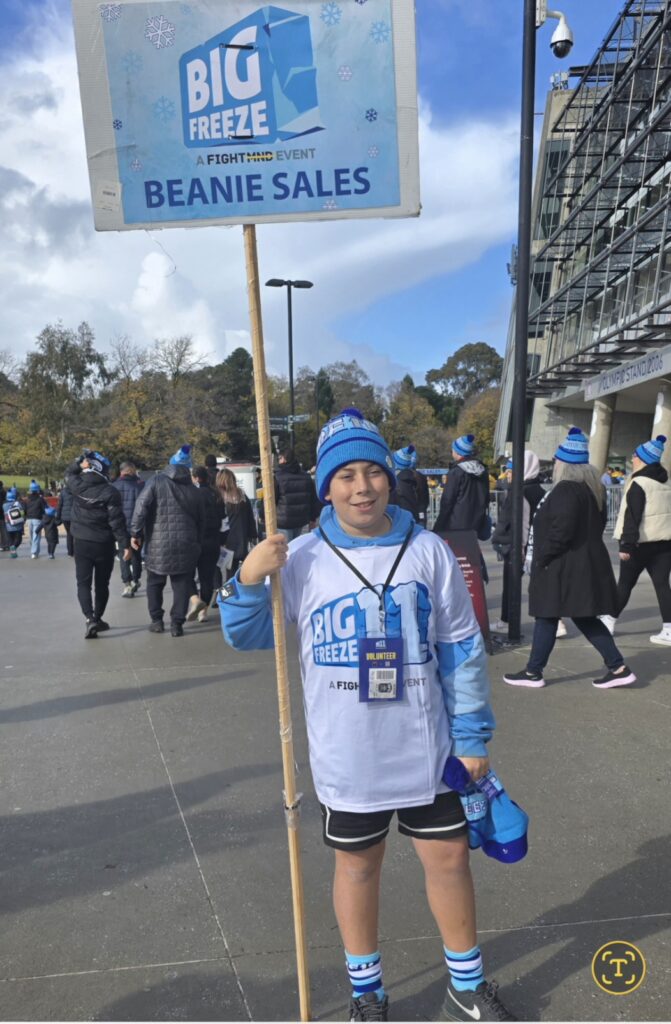
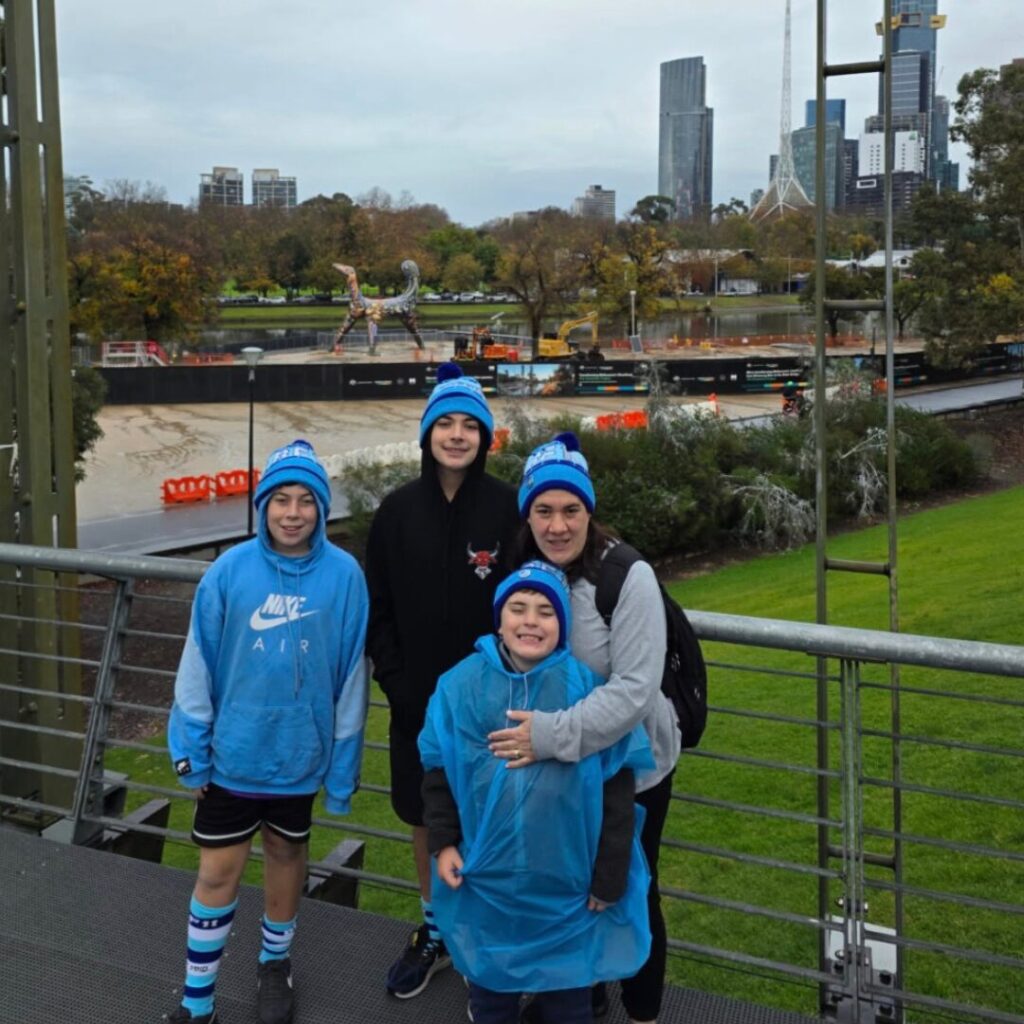
Each King’s Birthday, the MCG fills with the roar of Collingwood and Melbourne fans, but for Kerry Muratore and her three sons, 16-year-old Antonio, 13-year-old Marco and eight-year-old Mikey, the day is about more than football. Donning their blue Beanies and armed with donation tins, they join thousands of supporters in the FightMND Army, united in a mission to take a stand in the fight against the Beast that is motor neurone disease.  

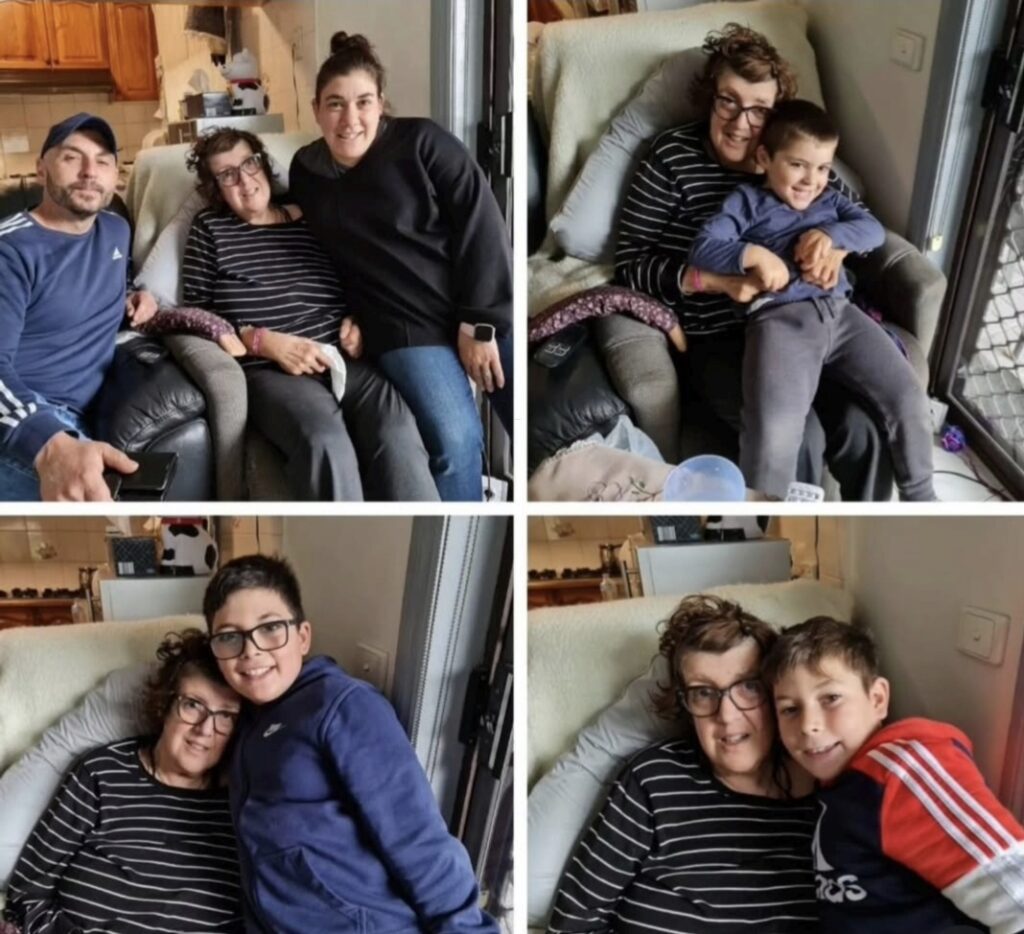
For the Muratores, volunteering at the Big Freeze is deeply personal. Their mum and yiayia, Mandy, was diagnosed with bulbar onset MND in 2020. She passed away just 16 months later at 62 years of age. She left behind her husband Michael, Kerry and her brother Trifon, son-in-law John, daughter-in-law Dimi and five grandchildren. “We volunteer in her memory, and the hope that one day a cure is found, so other families don’t have to experience the Beast that is MND,” Kerry says.   

Volunteers leading the charge 

For Kerry, Antonio, Marco and Mikey, the Big Freeze is more than fundraising. It’s about honouring Mandy, being part of something meaningful and connecting with people who care. Every member takes something different away from the experience.  

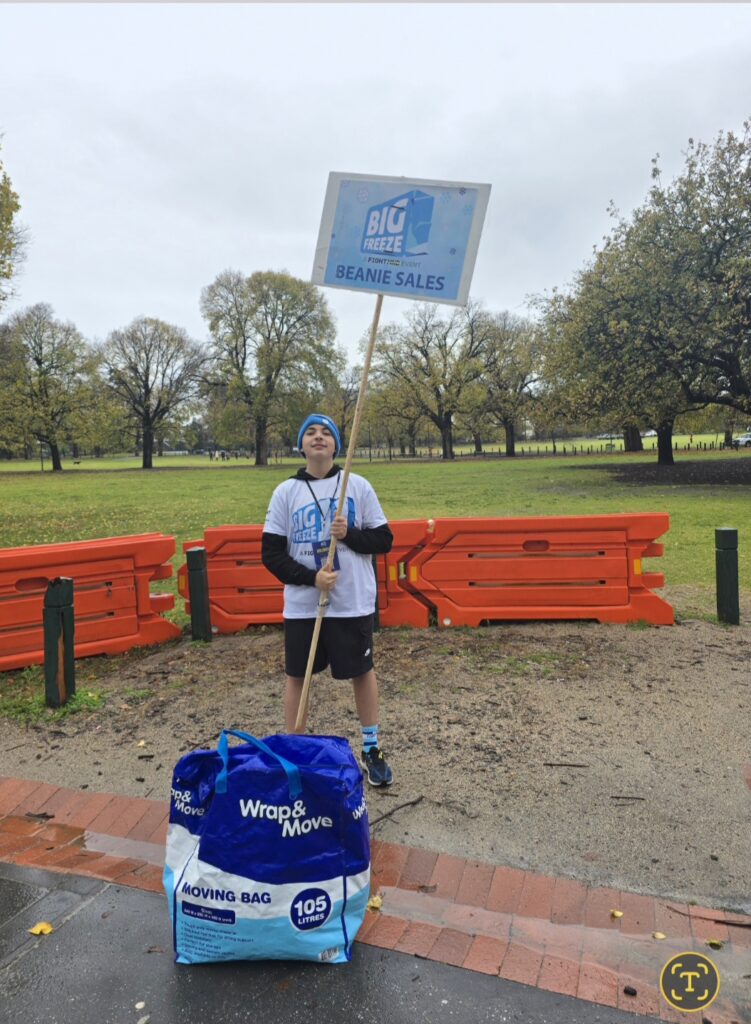
Mikey loves the hands-on excitement. “I like selling Beanies at the MCG in June,” he says. “It is a good way to spread awareness about MND, with many people being at the MCG,” shares Marco. Antonio finds purpose in every interaction. “It helps bring awareness to MND and is a meaningful way for me to honour my yiayia,” he explains. Kerry reflects on the experience, “Honouring my mum and raising as much as possible for a great cause.” 

For the family, volunteering is deeply rewarding. When asked to sum up the experience in one word, Mikey says “good,” Marco calls it “enjoyable,” Antonio “meaningful,” and Kerry simply says “rewarding.” It’s a day that combines fun, connection, and purpose, where every beanie sold and every donation collected feels like a step toward making a real difference. 

A call to arms: encouraging others to sign up 

The Muratore family wants others to experience the same sense of reward that comes from helping at the Big Freeze. When asked what they would say to someone thinking about volunteering, Mikey encourages, “If you want to be a volunteer for MND, you need someone to shake the cans and sell the beanies. It’s lots of fun, so have a try.” Marco adds, “Try it, even if it’s one year, as you meet lots of new people and it’s a great experience.” Antonio and Kerry both agree: “Give it a go, it’s such a rewarding day doing something positive that has a lot of meaning to many people.” 

Become a volunteer during Big Freeze 12 

This Big Freeze 12, you can join Kerry, Antonio, Marco and Mikey in making a difference in the fight against MND. We have volunteering opportunities across the country. From selling Beanies to collecting donations to raising awareness, you can help FightMND strive for a world free from MND. Expressions of interest for volunteering at Big Freeze 12 are now open. Register your interest today and help us move closer to a future without MND. 

Dr Sam Barton and the mini-brains unlocking big answers in MND research 

Dr Sam Barton and the mini-brains unlocking big answers in MND research 

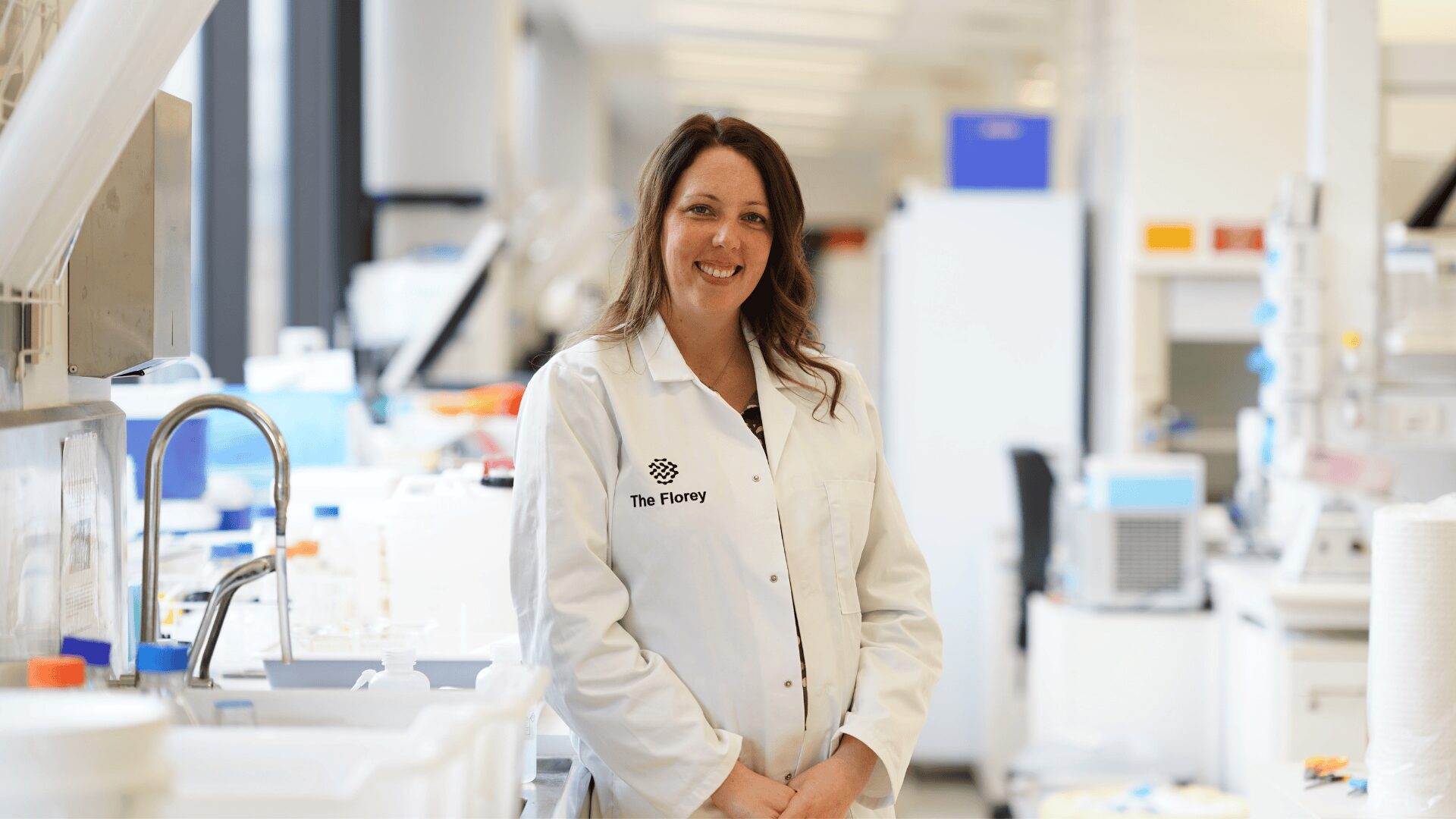
Inside The Florey Institute neuroscientist Dr Samantha Barton is leading an ambitious and imaginative project called Using iPSC-derived Organoids to Understand TDP-43 Pathology

Her goal? To better understand how motor neurone disease (MND) starts, spreads, and wreaks havoc on the nervous system. To do it she using something straight out of a science fiction novel. Mini-brains. 

These mini-brains, or organoids, are made from the stem cells of people living with MND. They’re three-dimensional clusters of living cells that mimic the behaviour of brain tissue, allowing scientists to watch how disease pathways unfold in real time. 

It’s a bold new way of studying MND. One that could help researchers uncover what triggers the disease and, one day, lead to treatments that slow or stop it. 

“Our goal is to understand what’s actually causing MND,” says Sam. “Only by uncovering the biology that drives disease onset and progression can we hope to find stronger targets for treatment.”     

Understanding how MND spreads 

MND doesn’t just affect motor neurons, the nerve cells responsible for movement, speech and swallowing. It also impacts the neighbouring support cells that keep those neurons alive and healthy. 

Sam’s research focuses on TDP-43, a sticky, toxic protein that builds up inside cells in nearly all people living with MND. Using organoids created from patient-derived stem cells, her team can observe how TDP-43 spreads between different cell types, disrupting the delicate balance of the nervous system. 

This approach provides an unprecedented window into how MND progresses inside the human body. By identifying the key processes driving that progression, Sam’s team hopes to reveal new targets for drugs that could protect neurons and preserve function for longer. 

“The establishment of our ‘mini-brain’ model will allow mechanistic insight into the drivers of MND,” she explains. “That means we’ll be able to identify novel targets and adapt them into a drug screening platform.” 

Collaboration at the cutting edge 

This project brings together some of Australia’s brightest minds in MND research. Sam’s team at The Florey is collaborating closely with researchers Dr Rebecca San Gil and Professor Adam Walker from the University of Sydney, alongside Dr Dmitry Ovchinnikov, combining world-leading expertise in stem cell biology and mouse modelling. 

Beyond the lab work, the project is helping to build research capacity by training new scientists, including a PhD student who is relocating to Australia to join the team. Together, they’re creating a model that will serve as an invaluable resource for MND researchers around the world. 

Powered by a 2025 FightMND IMPACT Grant 

This research has been made possible through a 2025 FightMND Impact Grant, supporting innovative projects that strengthen the global push to understand and treat MND. 

“FightMND’s support enables collaboration between leading MND researchers across Australia,” says Dr Barton. “It funds both our researchers and our research — helping us make discoveries that could one day translate into new treatments.” 

Hope for the future 

For Sam and her team, the science is deeply personal. The team at The Florey often hosts visits from people living with MND. Moments that remind them why their work matters. 

“I’m always humbled by how supportive they are of us and our research,” she says. “Even though our experiments might not help people living with MND right now, their encouragement inspires us to keep going. One day, we want to proudly share how our discoveries directly led to new drug options that change lives.” 

Sam’s long-term goal is to uncover the hidden drivers of MND and pave the way for new, life-changing therapies. Each mini-brain grown in the lab brings that vision one step closer. Proof that even the smallest discoveries can make a world of difference. 

Supporting research to beat the Beast 

Dr Sam Barton’s research is helping scientists better understand how MND starts and spreads. She is just one of many researchers whose work is made possible through FightMND funding. Research like this is vital to improving treatments and, one day, finding a cure for the Beast. But research takes time, and ongoing support.  

You can help fund this vital work. A donation to FightMND supports researchers like Sam and brings us closer to a future free from MND.  

Together, we can beat the Beast. 

2025: Beanies, Drives, Research, and Fighting MND Together

2025: Beanies, Drives, research and fighting MND together

What a year 2025 has been! As the year draws to a close, it’s time to press play on our highlights. From the icy thrills of Big Freeze 11 to creative DIY Big Freeze and a journey from the trees to the seas with Daniher’s Drive, Australians have shown that when it comes to fighting MND we don’t just take part. We take the plunge.  

The year our Patron became Australian of the Year 

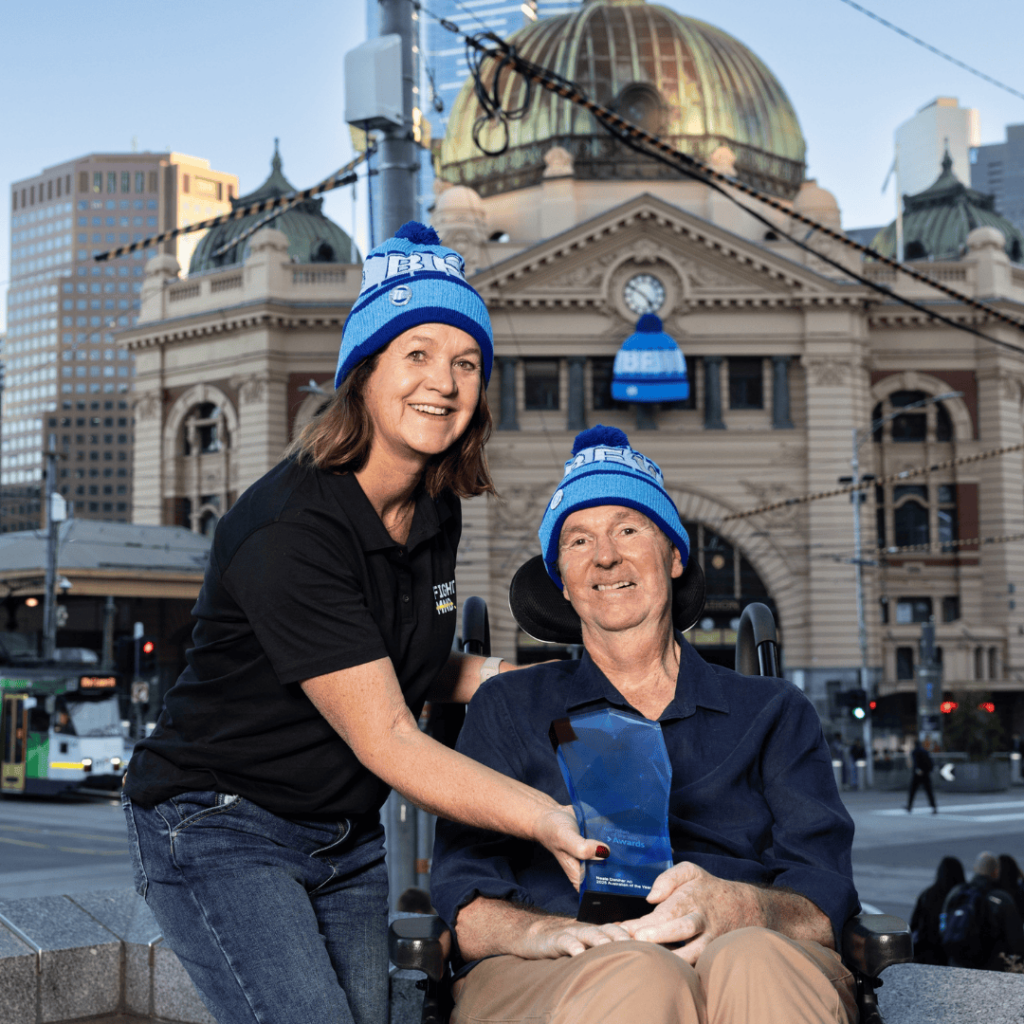
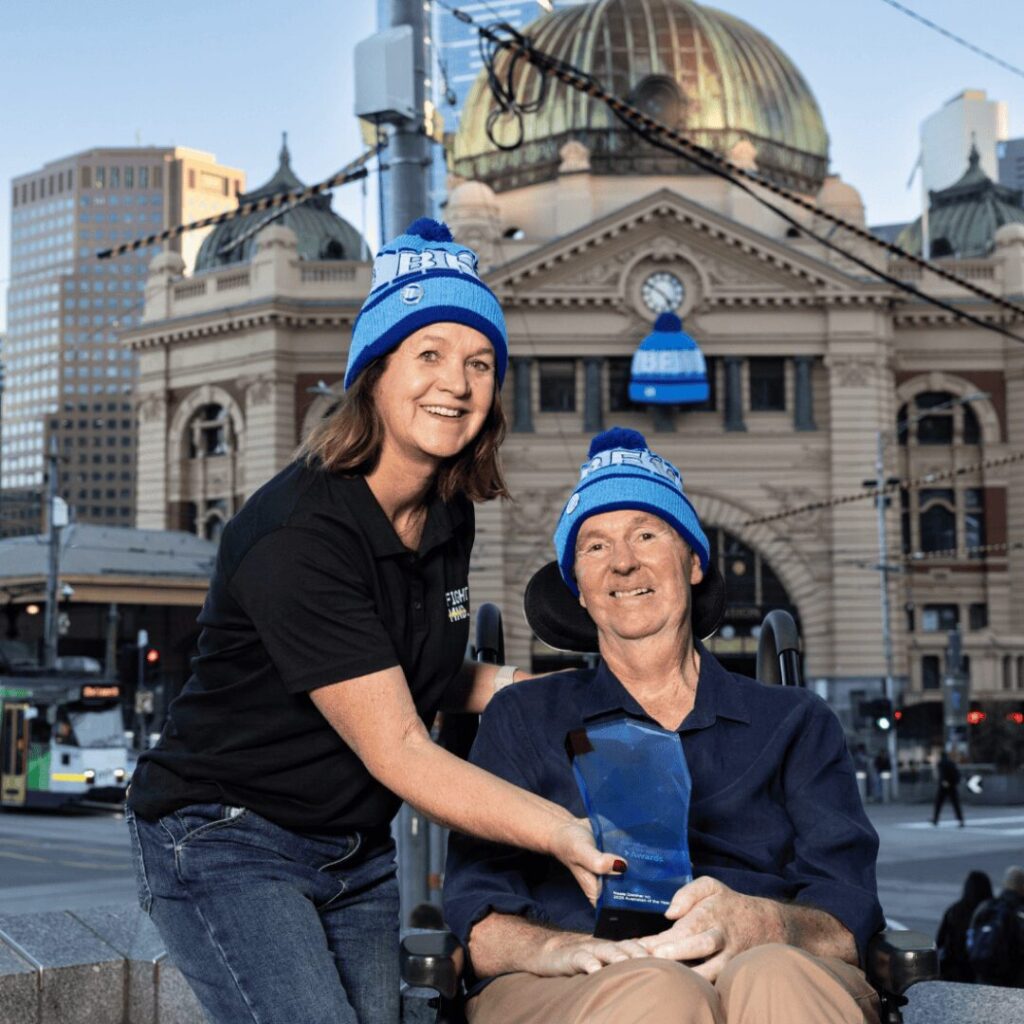
The year began with a milestone that set the tone for 2025. Our Co-Founder and Patron, Neale Daniher AO, was named Australian of the Year. This honour recognised his unwavering leadership and relentless advocacy for motor neurone disease research.  

Since being diagnosed with motor neurone disease (MND) in 2013, Neale has refused to let the Beast define him. Alongside Pat Cunningham and the late Dr Ian Davis (OAM), he co-founded FightMND. From the icy thrills of the Big Freeze to the road-tripping adventures of Daniher’s Drive, and many events in-between, Neale has inspired Australians to rally together, support research and fuel hope in the fight against the Beast.  

Your community, your freeze, your impact 

This year, Big Freeze in Your Community dared you to do and team up in the fight against the Beast. And you didn’t hold back.  

From schools to workplaces, local sporting clubs to family backyards, Aussies across the county embraced the challenge with imagination and determination. Every DIY Big Freeze and pair of Socks worn was a reminder that when Australians step up together, real change happens. 

You all continue to set the DIY Big Freeze bar high! Our team loves seeing how you bring a local twist to the battle against the Beast. We can’t wait to see what you’ll do for Big Freeze 12 in 2026.  

Live it forward: Big Freeze 11 makes a splash 

The MCG was a sea of blue Beanies as fans gathered for Big Freeze 11, embracing this year’s theme, Live it Forward. From the moment the crowd filled the stands, the energy was electric. Everyone united in the fight against the Beast and ready to cheer the sliders into icy glory. 

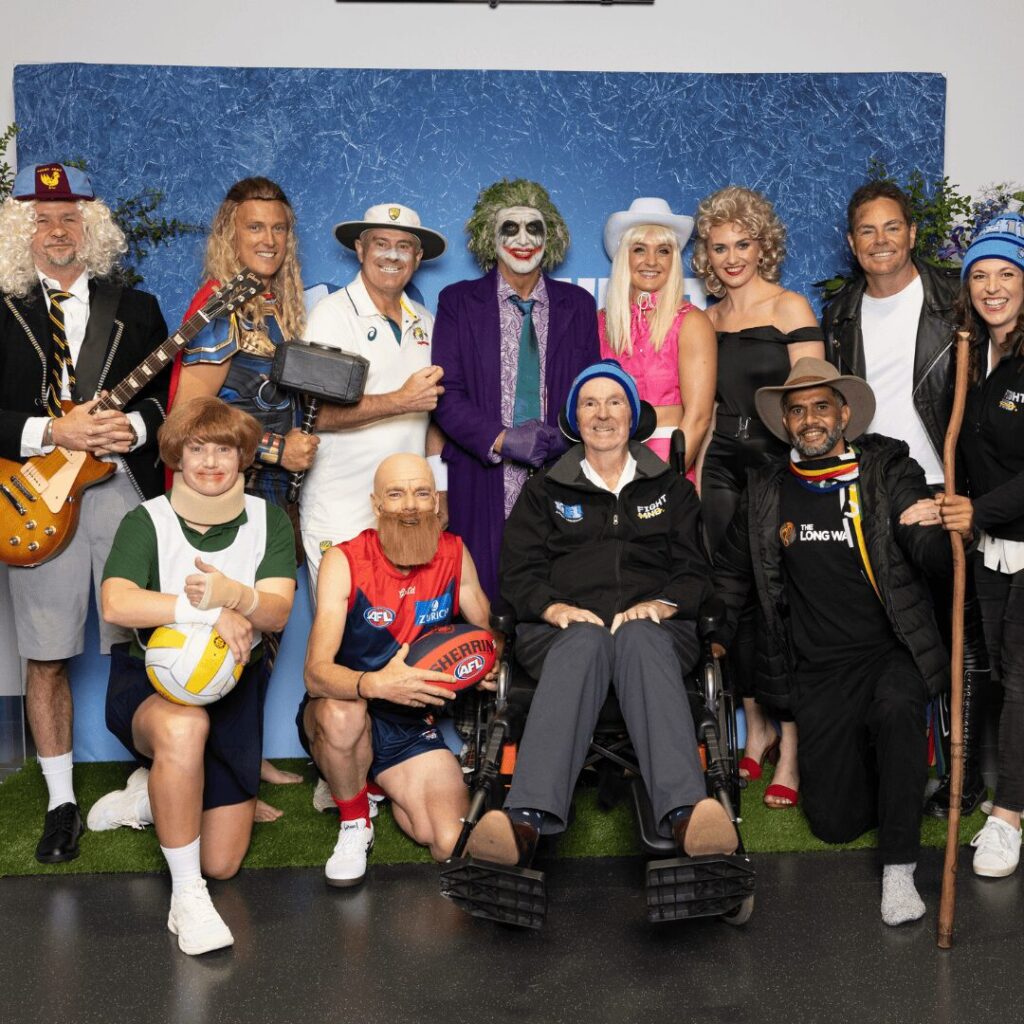
The plunge itself was nothing short of legendary, with our Sliders embracing the Aussie Icons theme. Swimming superstar Ariarne Titmus OAM kicked things off with a throwback as Olivia Newton-John, while cycling champ Cadel Evans AM showed his lighter side as Max Gawn, who, in big-hearted fashion, was at the bottom of the Slide cheering him all the way down! AFL icon Peter Daicos OAM brought his signature flair and showmanship as the unforgettable Heath Ledger, leaving fans in awe of his style and theatrics. Matt Nable rocked the slide as AC/DC’s Angus Young in a deeply personal tribute to his brother, who sadly passed from MND in 2024. 

Liz Watson dazzled as Margot Robbie, while Matt Shirvington brought the thunder as Chris Hemsworth’s Thor. Extra props for agreeing to don the costume (or at least the wig) on his flight home to Sydney! Alyssa Healy had the crowd in stitches as Magda Szubanski’s iconic Sharon Strzelecki, pash rash and all! Aaron Davey paid homage to a football great as Michael Long, and Craig Lowndes OAM went full throttle as Mad Max. Mark Taylor AO rounded out the line-up, spinning into icy glory as the master of spin, Shane Warne, his former teammate, making the plunge all the more special. 

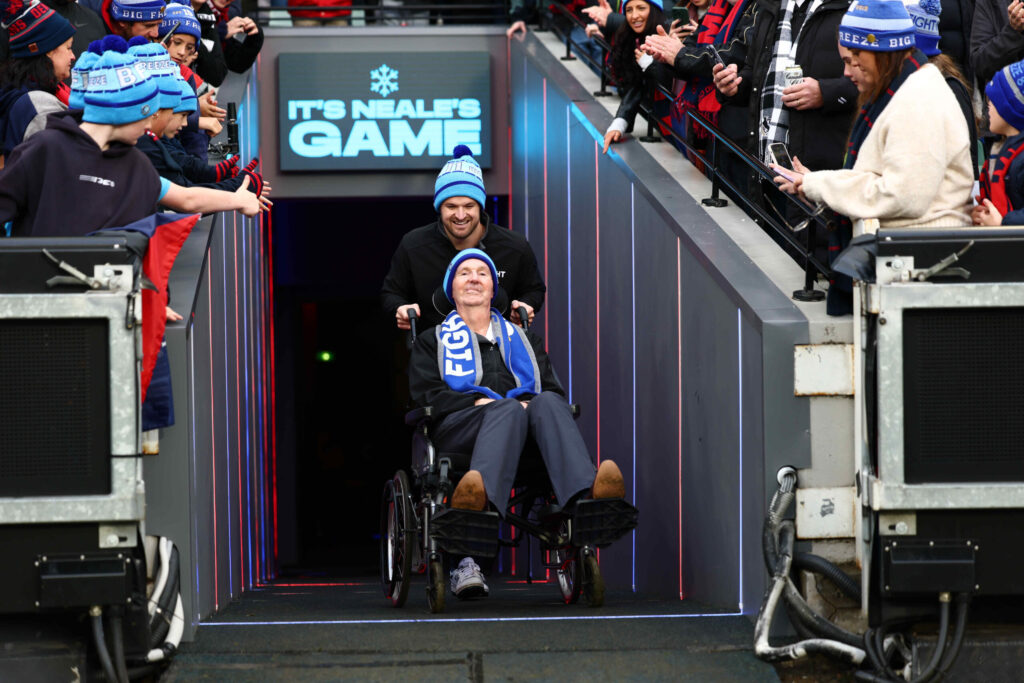
The day also had moments of pure emotion, with Neale’s lap of honour leaving everyone in awe, a moving reminder of courage, resilience, and why we come together each year for this incredible cause. 

At the heart of Big Freeze 11 were all of you. Whether you donned a Beanie in the stand, purchased a Digital Beanie at home, or were volunteering on the ground. Your support turned the country blue, showing that together, we’re living it forward and standing strong in the fight against the Beast.  

Big Freeze fever sweeps the nation 

2025 has been another unforgettable year for the State Freeze! Queensland, Western Australia, and South Australia brought their A-game once again with epic state freeze events. 

From coast to coast, fans showed up in droves to support FightMND, and the energy was off the charts. Huge thanks to the Adelaide Crows, West Coast Eagles, and Brisbane Lions (back-to-back Premiers – hear the roar!) for helping us turn freezing moments into real impact for the MND community. 

A special shoutout to all the incredible volunteers across the country who helped sell Beanies and collect donations at the State Freezes. Your support makes it all possible. 

Get ready… State Freezes are coming back in 2026! Stay tuned to find out what’s happening in your state.  
Second Global MND Research Roundtable drives action and collaboration 

Fast forward to September 2025, and the world’s top MND researchers, clinicians, and advocates gathered for the second Global MND Research Roundtable, building on the momentum from 2024. Over two days, they tackled five critical priorities: refining biomarkers, understanding asymptomatic disease, developing better human models, addressing under-represented populations, and bridging preclinical discoveries into clinical trials.  

The event sparked fresh ideas, challenged assumptions, and led to tangible outcomes: new working groups are forming across all priority areas, strategies are being translated into action and virtual follow-up sessions are planned. Stay tuned for more updates on the work of the Roundtable delegates. 

Challenging 27 in the fight against MND 

September also saw the return of Challenge 27, as Australians from coast to coast took on the challenge their own way to help fund vital MND research. What began as a simple call to move quickly grew into countless personal journeys. Sunrise walks, after-work runs and creative daily movements, all driven by a shared determination to fight MND. 

Why 27? It represents the average number of months someone lives after an MND diagnosis. Faced with that reality, our community chose action. 

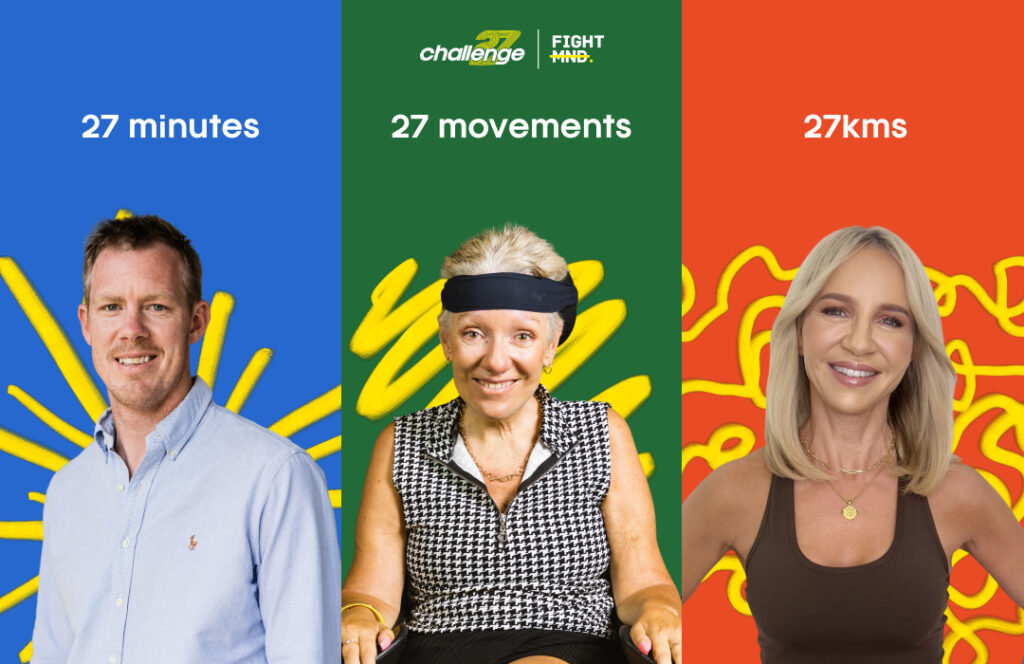
Leading the way were our Challenge Ambassadors. Jack Riewoldt encouraged people to give just 27 minutes each day, proving small efforts can have big impact. Leanne Sklavenitis, living with MND, completed 27 different movements, showing remarkable strength and adaptability. And Katrina Blowers challenged 27 kilometres in honour of her mum, who passed away from MND in 2024. 

Together, these stories, and the many others like them, transformed 27 into something powerful. Every step, stretch and kilometre helped honour loved ones, fund vital research and push us closer to a future free from MND. 

Daniher’s Drive travels from the trees to the seas 

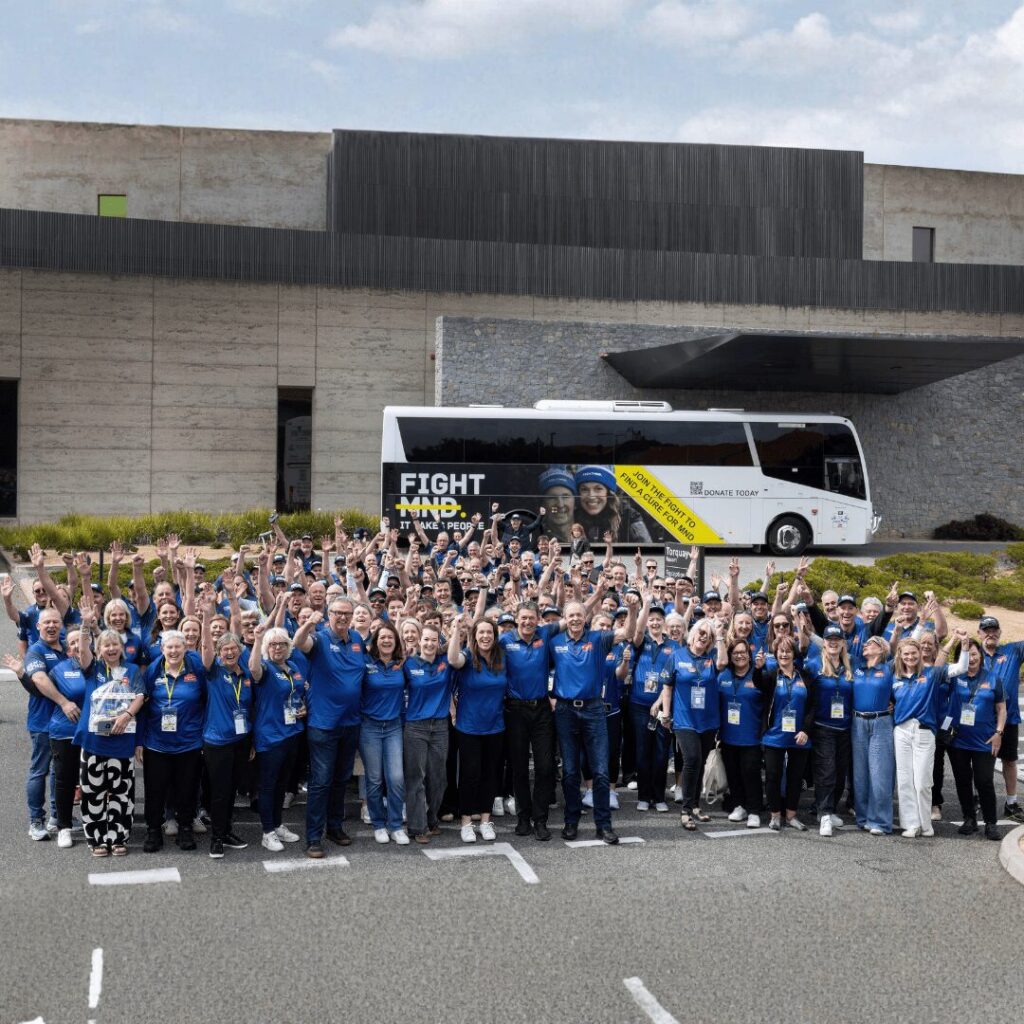
October 2025 saw Daniher’s Drive set out on its epic journey, From the Trees to the Seas, with more than 220 drivers departing from Heidelberg Golf Club, embracing the road, the challenge, and the cause.  

On day one the convoy paused at Assumption College, Kilmore, where founder Neale Daniher AO experienced a heartfelt reunion with his old school and the pavilion bearing his name. It was a special moment which set the tone for this year’s Drive. 

From winding forest roads to sparkling coastal stretches, every mile carried stories of community and hope. Capping off the event was the Legends of the land Down Under fancy dress gala where, true to tradition, the crowd belted out Neale’s favourite song, Mr Brightside by the Killers.  

From our Drive participants and sponsors to the communities who welcomed us with open arms, thank you to everyone who shared the 2025 Drive. We can’t wait to continue the journey in South Australia in 2026. 

Record Investment in MND Research in 2025 

In 2025, FightMND committed a record $22.9 million to MND research and care projects. This year, we’re proudly supporting 21 innovative research projects, from clinical trials and cutting-edge drug development to projects seeking to unravel the complexities of MND. This year’s investment also aims to empower emerging and established researchers to push the boundaries in the fight against the disease. 

We also invested $1.4 million into vital care projects focused on improving day-to-day support, nutrition, ventilator support and equitable care for Australians living with MND. 

Each project and initiative brings us closer to breakthroughs, better care and a brighter future for the MND community. Curious to learn more about this year’s funded projects? Check out our News section to learn more about the research your support is helping. 

Thank you for all your support in 2025! 

It has been another incredible year in the fight against the Beast. 

To everyone who volunteered, hosted a DIY event, participated in a Community Round, joined us on Daniher’s Drive, purchased socks, grabbed a Beanie, or donated throughout 2025, thank you. 

Thanks also goes to our amazing corporate partners who continue to stand shoulder to shoulder with us.  

It takes people to win this fight. Everything we’ve achieved this year has been because of you. Your support helps researchers continue their work towards better treatments, and one day, a cure for MND. More than that, it shows those living with MND, their families, and carers that they are not alone. 

While progress continues, the journey is far from over. So, we keep fighting. Keep working towards our vision of a world free of MND. 

We go again. 

Mark my words: How Tasmania’s equipment library transforms life for people living with MND 

Mark my words: How Tasmania’s equipment library transforms life for people living with MND 

For Tasmanians living with motor neurone disease (MND) staying safe, independent and connected to the community can depend on having the right equipment at the right time. But for many, accessing essential assistive technology can be painfully slow. This is why MND Tasmania’s equipment library has quickly become a vital lifeline. 

Chris Symonds knows firsthand how essential this service is. As President of MND Tasmania, Chris has been instrumental in the establishment of the state’s equipment library. “Equipment libraries are vital in precuring new or used assistive technology and then distributing these to people living with MND or Kennedy’s Disease,” Chris says. “For those over the age of 65 who are ineligible for NDIS funding, MND Tasmania provides this essential equipment at no cost.” 

The library provides a wide range of equipment, including lift chairs, adjustable beds, power wheelchairs, bathing supports and specialist communication or breathing devices. Everything that can help someone stay safe and independent for as long as possible. People are connected to the service through their MND Advisor, who works with them to identify what equipment they need and when they need it most. 

Demand is constant, and every situation is unique. “For those living with MND, the rate of progression and areas affected vary from person to person. This means individual equipment needs vary,” Chris explains. That’s why the library is shaped not only by clinical advice, but by the lived experiences of people with MND. Ensuring the support provided truly meets their changing needs. 

For families navigating a rapidly progressing disease, timely equipment can be life-changing. It helps people maintain mobility, continue daily routines, stay socially connected and live safely at home for as long as possible. But when access is slow, abilities can be lost before the needed equipment arrives. The equipment library exists to close this critical gap, restoring dignity, independence and a sense of control when it’s needed most. 

Its impact comes from speed. “The aim of our equipment library is to provide items quickly,” Chris says. “Other state-based or NDIS approvals can have slow responses to the need and often when the item arrives the person’s condition has progressed and is ready for the next item.” 

Chris has experienced this delay himself. Living with Kennedy’s Disease, an inherited disease affecting the neurones in the brain, he knows firsthand how importance timely access can be. Under the NDIS he waited six months and 11 days for his power wheelchair to arrive, even though the approval itself took only 15 days. In contrast, his cousin, over 65 and not on the NDIS, received a similar second-hand power chair through an equipment scheme in just two weeks. “It did the same job. Speed matters.” 

Operating the library in a small state brings challenges, particularly the high costs of maintaining specialised equipment. That’s where strong partnerships are essential. “MND Tasmania works closely with our partner, Country Care, to deliver the service. This partnership is essential to the delivery of the library,” Chris says. By combining Country Care’s logistical expertise with MND Tasmania’s community focus, the program has built a solid foundation. 

Community donations and support are also critical to the library’s growth. FightMND is investing in this initiative, helping MND Tasmania strengthen its equipment pool and accelerate access for those who need it most. 

Chris’s message to Australians is clear. “MND progresses quickly. Equipment libraries help people stay safe at home and active in their community not stuck in hospitals or aged care. Supporting these libraries is supporting dignity, independence and quality of life.” 

Thanks to Chris and his team this equipment library is making a meaningful difference for Tasmanians living with MND.  

Mark My Words: Your support powers projects supporting Australians living with MND 

MND Tasmania’s equipment library is a lifeline, providing critical equipment quickly so people affected by MND can maintain their independence and dignity. Your support helps FightMND fund essential projects like this, empowering families and improving care across Australia. 

Mark my words: together, we can make a difference. Every donation accelerates research, funds innovative care and empowers people living with MND. Join the fight today. Together we can create a future without MND.