Julie’s Story: From discovery to possibility in MND research
For people living with motor neurone disease (MND), time is everything. With limited treatment options and rapid disease progression, the need for new therapies has never been more urgent.
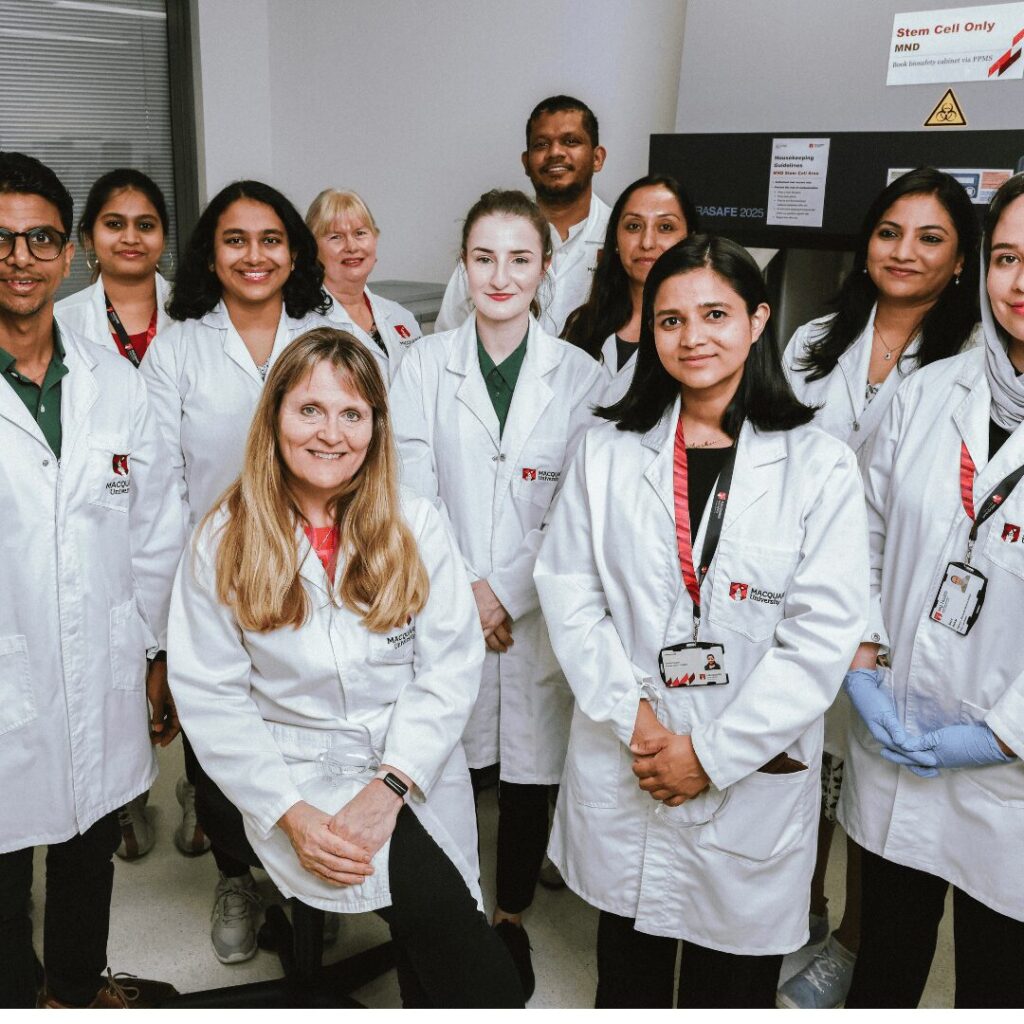
That’s why Professor Julie Atkin, Professor of Neurobiology at Macquarie University’s Macquarie Medical School, is leading a promising new research project supported by a 2025 FightMND Drug Development Grant.
Julie’s project, Repurposing Diazepam as a New Therapeutic Approach for MND, takes a practical and innovative approach; investigating whether a widely used drug could be redirected to treat MND.
“This project will examine whether a known drug, for which extensive research already exists, has the potential to be a new treatment for MND,” Julie explains. Diazepam is a medicine that has been used by doctors all over the world for more than 60 years. Because it has been studied so much, scientists know it is safe, easy to access, and affordable. This makes it a strong and practical option to test as a possible new treatment for MND.
Repurposing existing medicines can reduce the time and cost required to bring new treatments to patients. While developing a new drug can take up to 20 years and cost billions of dollars, repurposing could reduce that timeline to just a few years. For a disease like MND, where progression is rapid and options are limited, this efficiency could be transformative.
Julie’s team will test diazepam in mouse models of MND that develop paralysis, muscle weakness, impaired movement, and motor neuron loss similar to those seen in people with the disease. “If the drug prevents these key features in MND mice, it will provide strong evidence of its potential to treat these characteristics in humans,” Julie says.

Importantly, the research targets early disease mechanisms. Motor neurons become overactive early in MND, and abnormal accumulation of the TDP-43 protein, a hallmark of the disease, occurs in around 97 per cent of cases. Targeting these processes early may offer a more effective therapeutic strategy than treating symptoms later in the disease course.
People living with MND are already helping shape the research. Julie’s team has engaged with the Australian Lived Experience Network and works closely with the Macquarie Neurology Clinic, which cares for around 10% of Australia’s ALS patients. This close connection ensures the research remains grounded in real-world needs and priorities.
This work would not be possible without FightMND’s support. “Preclinical drug development is extremely difficult to fund, yet it is a critical step in translating discoveries into treatments,” Julie says. “Without FightMND’s support, it would be impossible for us to test whether this drug has the potential to be repurposed for MND. By funding projects like this, FightMND is addressing a vital gap in research and accelerating the search for effective therapies.”
Celebrating women in MND research
Professor Julie Atkin is just one of many extraordinary women leading vital research into MND in Australia and around the world. Female scientists are advancing MND research at every level; from uncovering the biological mechanisms driving the disease, to developing and testing urgently needed new treatments.
Their work extends beyond the laboratory, connecting science with lived experience through collaboration with clinicians, patients and families. By mentoring early‑ and mid‑career researchers and championing innovative ideas, these women are helping to build a stronger, more connected MND research community for the future.
On this International Day of Women and Girls in Science, we celebrate the dedication, leadership and compassion of women like Julie, whose research brings hope to people affected by MND. To all the incredible women working to help us beat the Beast: thank you for your science, your determination and your commitment to a world free from MND.